
Psalms of David
David is in a pickle yet again. The incident in the title is in 1 Samuel 19 when Saul is trying to kill David but David’s wife Michal, who is also Saul’s daughter, warns David who escapes in the night.
-o0o-
Psalms in Book 2 are like Book 1 in that they are mostly lament and distress although they now include a communal voice in addition to the singular voice of the first book.
The books of Psalms are roughly themed like this:
Book 1: Psalms 1 – 41: God is beside us.
Book 2: Psalms 42 – 72: God goes before us
Book 3: Psalms 73 – 89: God is all around us.
Book 4: Psalms 90 – 106: God is above us.
Book 5: Psalms 107 – 150: God is among us.
To the choirmaster: according to Do Not Destroy. A Miktam of David, when Saul sent men to watch his house in order to kill him.
59 Deliver me from my enemies, O my God;
protect me from those who rise up against me;
2 deliver me from those who work evil,
and save me from bloodthirsty men.
3 For behold, they lie in wait for my life;
fierce men stir up strife against me.
For no transgression or sin of mine, O Lord,
4 for no fault of mine, they run and make ready.
Awake, come to meet me, and see!
5 You, Lord God of hosts, are God of Israel.
Rouse yourself to punish all the nations;
spare none of those who treacherously plot evil. Selah6 Each evening they come back,
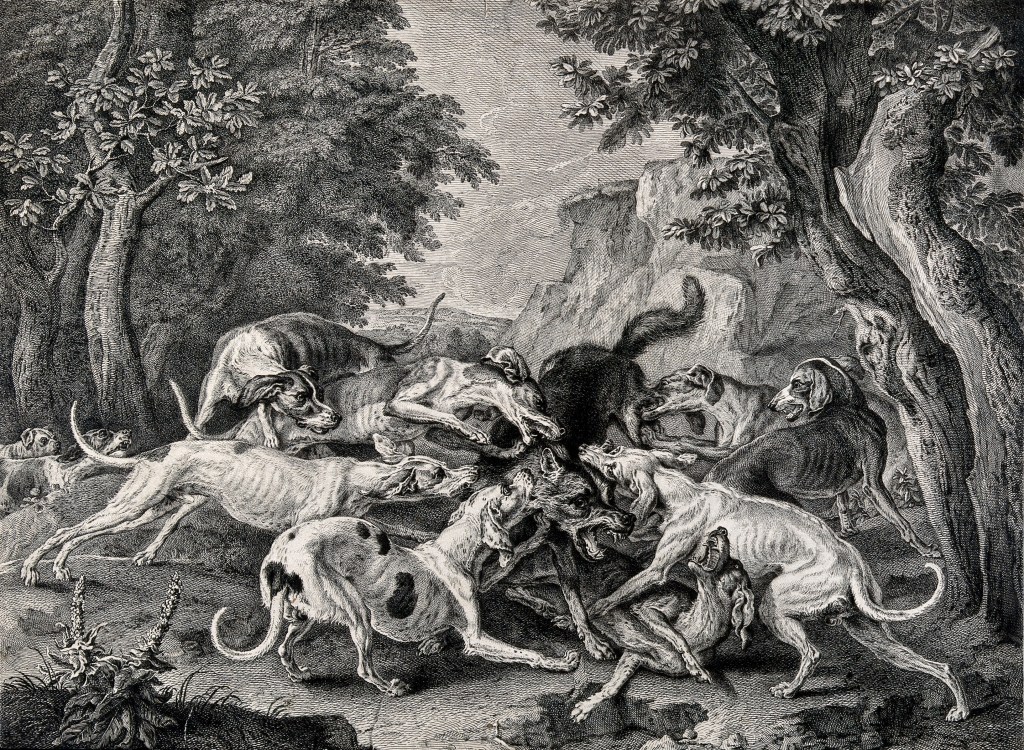
howling like dogs
and prowling about the city.
7 There they are, bellowing with their mouths
with swords in their lips—
for “Who,” they think, “will hear us?”8 But you, O Lord, laugh at them;
you hold all the nations in derision.
9 O my Strength, I will watch for you,
for you, O God, are my fortress.
10 My God in his steadfast love will meet me;
God will let me look in triumph on my enemies.11 Kill them not, lest my people forget;
make them totter by your power and bring them down,
O Lord, our shield!
12 For the sin of their mouths, the words of their lips,
let them be trapped in their pride.
For the cursing and lies that they utter,
13 consume them in wrath;
consume them till they are no more,
that they may know that God rules over Jacob
to the ends of the earth. Selah14 Each evening they come back,
howling like dogs
and prowling about the city.
15 They wander about for food
and growl if they do not get their fill.16 But I will sing of your strength;
Psalm 59 ESVUK
I will sing aloud of your steadfast love in the morning.
For you have been to me a fortress
and a refuge in the day of my distress.
17 O my Strength, I will sing praises to you,
for you, O God, are my fortress,
the God who shows me steadfast love.
Do Not Destroy, in the psalm title is seen as either the name of a tune the psalm is set to or a liturgical direction according to the notes in English translations of the Bible. But some of the Rabbis disagree. I have looked at Jewish sources because the psalms are the Jewish hymn book. Some Rabbis say that Do Not Destroy means do not destroy literally. David is asking for his life to be spared.
In my search of the archives, I came across another surprise. Modern theologians commenting on Psalm 59 concentrate on the meaning of the psalm literally, what it would have meant to the original readers. The Church Fathers, church theologians who lived in the first and second centuries AD, say the psalm is about Jesus. The events of the psalm have a parallel with the events of the trial of Jesus. I have to admit the connection is there, except that the request for God to consume David’s enemies in wrath in verse 13 has its equivalent in Jesus praying, “Father, forgive them, they don’t know what they are doing.” Are these opposites? No. The calling down of curses is linked to the Messiah’s coming kingdom of justice, and Jesus taught that sins have consequences. What Jesus offers is mercy and grace.
Taking a strictly literal view of Psalm 59 causes problems. The title says those persecuting David were Saul and his men, but the text of the song reads foreigners. Some have said that David must have written the Psalm later, during his time as king, referring back to his time as a fugitive. That is not necessary, this is poetry and even the most conservative of statements on the Bible, the Chicago Statement on Biblical Inerrancy 1978, says that “history must be treated as history, poetry as poetry, hyperbole and metaphor as hyperbole and metaphor, generalization and approximation as what they are, and so forth.” Psalms are poetry and should be read as such. This song is addressed to the God of Israel so it follows that the country’s enemies should be included with personal enemies.
The imprecatory psalms are about calling on the Justice of God. Psalm 59 is no exception. Biblical lament is often seen as being prophetic, the Church Fathers saw that the way this psalm points to the trial of Jesus, which we need to look to if we are to see how God’s justice works. In the trial of Jesus retribution was what the Jewish authorities were about. Jesus was an innocent victim. Yet the justice of God can be seen in Jesus willingly taking on the punishment that the world deserved.
The only part of Psalm 59 that I have neglected so far is the refrain. Or at least what is used as a refrain, as it is in two parts. The first part, verses 6 and 14, is repeated, “Each evening they come back, howling like dogs and prowling about the city.” The second part is different. For the first time, when David is setting out his predicament, these people are compared to predatory dogs with swords in their lips. In the second refrain these dogs are back but now there is nothing for them. Although it is written in the first person Psalm 59 is a corporate song of how God keeps his people safe if they trust him.
< Psalm 58 | Psalm 59 | Psalm 60 >
< Previous | Psalms of David | Next >
 Making an ass of myself