
The last song in the second book of Psalms is a song of praise. It is a royal song talking about the kings of Israel ruling the whole world. Why should a white man like me think this is a good thing? The kings of Israel were not white.
|
-o0o-
|
Psalms in Book 2 are like Book 1 in that they are mostly lament and distress although they now include a communal voice in addition to the singular voice of the first book.
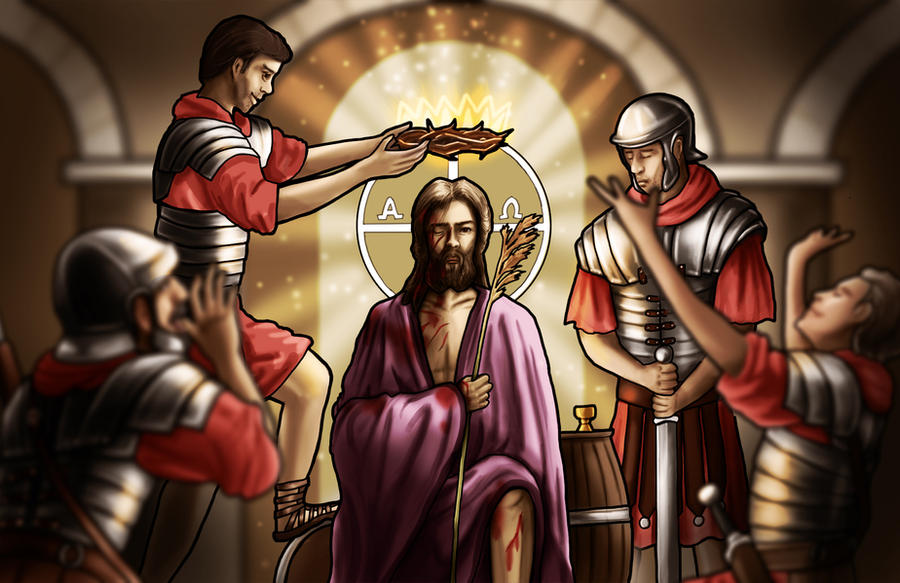
used under a CC BY-NC-ND 3.0 DEED licence
The books of Psalms are roughly themed like this:
Book 1: Psalms 1 – 41: God is beside us.
Book 2: Psalms 42 – 72: God goes before us
Book 3: Psalms 73 – 89: God is all around us.
Book 4: Psalms 90 – 106: God is above us.
Book 5: Psalms 107 – 150: God is among us.
Of Solomon.
72 Give the king your justice, O God,
and your righteousness to the royal son!
2 May he judge your people with righteousness,
and your poor with justice!
3 Let the mountains bear prosperity for the people,
and the hills, in righteousness!
4 May he defend the cause of the poor of the people,
give deliverance to the children of the needy,
and crush the oppressor!5 May they fear you while the sun endures,
and as long as the moon, throughout all generations!
6 May he be like rain that falls on the mown grass,
like showers that water the earth!
7 In his days may the righteous flourish,
and peace abound, till the moon be no more!8 May he have dominion from sea to sea,
and from the River to the ends of the earth!
9 May desert tribes bow down before him,
and his enemies lick the dust!
10 May the kings of Tarshish and of the coastlands
render him tribute;
may the kings of Sheba and Seba
bring gifts!
11 May all kings fall down before him,
all nations serve him!12 For he delivers the needy when he calls,
the poor and him who has no helper.
13 He has pity on the weak and the needy,
and saves the lives of the needy.
14 From oppression and violence he redeems their life,
and precious is their blood in his sight.15 Long may he live;
may gold of Sheba be given to him!
May prayer be made for him continually,
and blessings invoked for him all the day!
16 May there be abundance of corn in the land;
on the tops of the mountains may it wave;
may its fruit be like Lebanon;
and may people blossom in the cities
like the grass of the field!
17 May his name endure for ever,
his fame continue as long as the sun!
May people be blessed in him,
all nations call him blessed!18 Blessed be the Lord, the God of Israel,
Psalm 72 ESVUK
who alone does wondrous things.
19 Blessed be his glorious name for ever;
may the whole earth be filled with his glory!
Amen and Amen!
20 The prayers of David, the son of Jesse, are ended.
Psalm 72 is one of two songs attribued to or dedicated to Solomon. The other one is Psalm 127.
The song is in three parts whichare then repeated in the same order (Psalms typically repeat in reverse order).
Saviour of the poor and needy (verses 1-4 and 12-14).
An enduring reign (verses 5-7 and 15-17a)
Worldwide dominion (verses 8-11and 17b-19).
Verse 20 just marks the end of the second book of Psalms, that’s it! It’s mostly true that the prayers of David, son of Jesse are done here. In Book 1, David was the star, but in Book 2, we get songs from the Sons of Korah in the first part and David in the second part. Don’t worry, there are more Davidic psalms to come, but they become a bit scarce in Book 3 and Book 4, with only one and two of his songs respectively. Book 5 brings back several Psalms of David, mostly in a section right before the final five praise songs. But we gotta keep it real, the compilation of Psalms Book 5 is actually from a post-exilic period. Phew, enough Psalms knowledge for now!
All of the last paragraph is not relevant to the meaning of Psalm 72 itself, i just went down the rabbit hole that is the internet, getting distracted. Again.
Saviour of the poor and needy
This is a majestic psalm with the opening words, “Give the king your justice.” In the modern age, when politicians discuss justice, it may seem focused on punishment. However, this perspective only captures part of the truth. While there are indeed various punishments for specific offenses mentioned in both the Old and New Testaments, justice encompasses much more. It encompasses fairness, compassion, and the restoration of harmony in society. Let us remember that justice has the power to bring about positive change and renew our hope for a better world.
God’s justice is not the justice of the world. The rich, famous and powerful are not able to buy justice for themselves, which people with lesser means do not have access to. God is fair to all people, rich or poor, famous or unknown, powerful or powerless. “May he defend the cause of the poor of the people, give deliverance to the children of the needy, and crush the oppressor!” says Solomon in verse 4. This is the true meaning of “And justice for all,” those words from the USA’s Pledge of Allegiance.
That is not to say God is neglecting the rich, famous and powerful. To those who have spent their lives chasing riches, fame and powerI have this to say, using the words of Jesus in Matthew 6:5: You have already received your reward.
An enduring reign
The specific relevant content for this request, if necessary, delimited with characters: The song could well be about the events in Solomon’s lifetime. The mention of Sheba brings to mind the Queen of Sheba who came to King Solomon, bringing spices, gold, and precious stones. Some claim that these verses are prophetic and point to the worldwide reign of Jesus. That could be true, but verse 17 does not claim that Solomon will reign forever but that his name, his fame, and renown, will continue. Which it does. Solomon is mentioned not only in Jewish and Christian scriptures but also in the Quran.
What verse 17 does is quote God’s promises to Abraham and extend them to the dynasty of David and Solomon. Whether that verse points to Jesus depends on whether this promise to Abraham is messianic.
Is the psalm about Solomon or Jesus? I’d say both. Prophetic writings take current events and apply them to the future. The section in verses 5-7 is quoted by the prophet Isaiah, or quotes from Isaiah. Which of these was written first makes no difference to whether it is prophecy.
It is also quoted indirectly in the New Testament. Zechariah sings of a horn of salvation that is coming, a horn being a strong king, (Luke 1:69) and Paul writes of Jesus as our peace making twogroups one, which points back here (Ephesians 2:14). Hearing of two groups of people becoming one leads on to the next section.
Worldwide dominion.
The kingdom is going to be everywhere. It will include these groups:
10 May the kings of Tarshish and of the coastlands
render him tribute;
may the kings of Sheba and Seba
bring gifts!
Where are these places?
Tarshish could be in Spain, around modern Cadiz, or even Cornwall, UK. Berber traders from Morocco were trading tin from Cornwall and lead from south Wales dropping them off as a trading point in Cadiz. Cornish tin has been found in bronze from this period in the eastern Mediterranian.
Sheba is regarded as modern Ethiopia and Seba is identified by the historian Josephus as an island off modern day Eritrea.
What makes these individuals truly remarkable is not their physical location, but rather their unique appearance in comparison to the people of Israel. With Europeans having fair skin and Ethiopians having darker skin tones, they stood out amidst the predominantly brown-skinned Jewish population. This serves as a powerful reminder that the worship of God knows no boundaries and is accessible to all, irrespective of their racial background. It highlights the inclusivity and universality of spiritual devotion.
Many people have taken inspiration from this ancient song. In the 18th Century a time when the British Empire was expanding, Isaac Watts used Psalm 72 as inspirationfor the hymn Jesus Shall Reign Where’er the Son, a reminder that it was Jesus who would reign.
This section is not to be taken alone. The context is the whole psalm. Having dominion does not mean taking a superior attitude to other people. The poor of the people and the children of the needy will not be neglected no matter where they are from.
The kingdom of Jesus will be a kingdom defined by justice, and fairness, for all people of all races.
|
-o0o-
|
< Psalm 71 | Psalm 72 | Psalm 73 >
 Making an ass of myself