
Understanding atonement
Lent 2024 – Part 8, Christus Victor
This Lent, I reflect deeply on the profound significance of Jesus Christ’s death and resurrection, exploring the various theories embraced or historically cherished by Christian churches. This journey reveals a rich tapestry of beliefs and interpretations. It’s important to acknowledge that there is more than a single perspective, and for those who have engaged in discussions about them, there are way more than the two you have argued over.
Changing what you believe about atonement is not denying Jesus. The gospel is not a description of how Jesus’ death (and resurrection, ascension, and enthronement) rescues the world, but that it does so. The gospel is not a theory or advice; it is news.
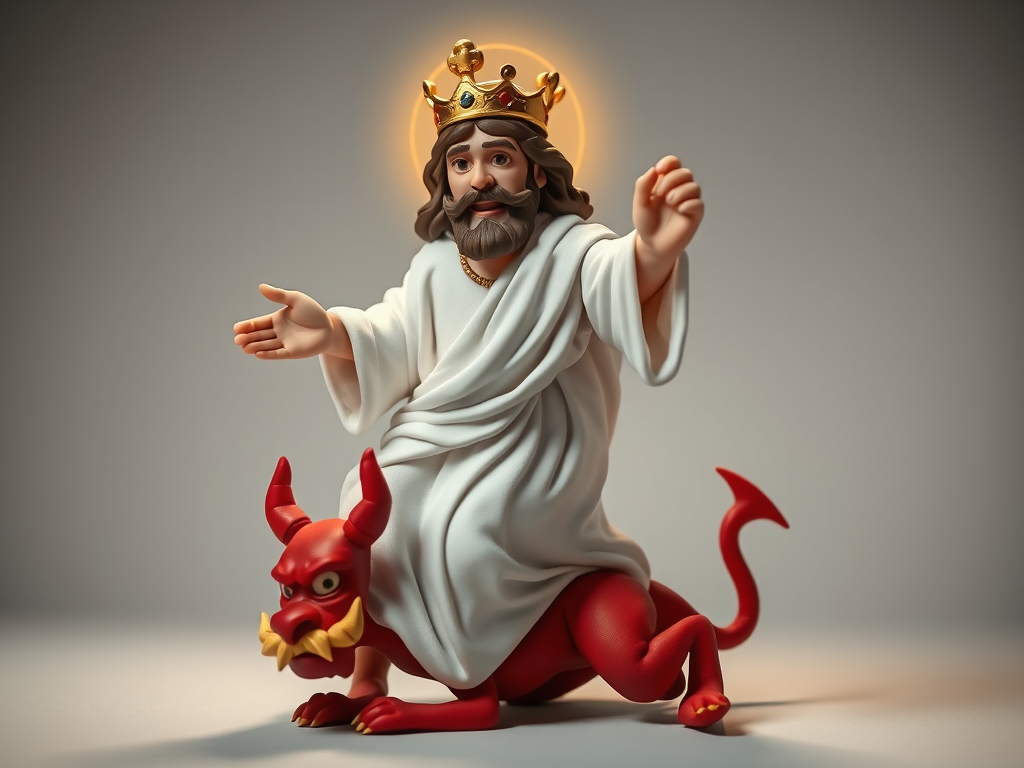
This is one of six theories that look at Jesus paying a ransom which developed over time.
- The ransom was paid to Satan
- The ransom was paid to God
- Satisfaction
- Penal Substitution
- Governmental
- Christus Victor
A lot of what I have written reflects a profound history that connects us to our spiritual roots. In the 12th Century, Anselm poignantly portrayed God through the image of a feudal king, conveying the heartfelt notion that Christ’s death honored God. Fast forward to the 16th Century, where the Reformers emphasized that Christ’s sacrifice was deeply intertwined with God’s justice, a concept that resonates with many of us. Then, in the 17th Century, Hugo Grotius brought to light the idea of God’s mercy in this sacrifice, nurturing a sense of hope and compassion. While these thinkers offered various substitutionary theories—highlighting how Christ died in our place—they all shared a beautiful message about the victory of Christ over sin, death, and Satan.
33 I have said these things to you, that in me you may have peace. In the world you will have tribulation. But take heart; I have overcome the world.”
John16:33 ESVUK
4 For everyone who has been born of God overcomes the world. And this is the victory that has overcome the world—our faith. 5 Who is it that overcomes the world except the one who believes that Jesus is the Son of God?
1 John 5:4-5
All was well up until the 20th Century; new theories emerged as an extension of those foundational ideas. Yet, it baffles me to consider why, in 193,0 Gustaf Aulén felt compelled to write Christus Victor (translated into English the next year). The concept of Christ the Conqueror, so rich and enduring, had certainly not faded into obscurity. In fact, we can still feel its presence in the beautiful Protestant Easter hymns crafted before 1930.
What Aulén did was to go right back to the theory of a ransom paid to Satan, the dominant theory before Anselm, whose ideas and those that followed were about a payment to God. Up to then, the teachings of the early saints were either missing or downplayed in Evangelical thought. A theory where the early teachings of the first Christians were either ignored or made secondary to a Christ alone and scripture-only Christians was a good thing? Maybe, maybe not. Having a theory that emphasises Christ the Conquerer of sin, death, and the devil, is it a good thing? Yes, it is a great thing to have.
Understanding anger
Understanding the anger, as well as the love and justuce of God is important. There are two Greek words in the New Testament for anger. One signifies energy and zeal; the other conveys a dynamic intensity. These words are respectively Orge (pronounced or-gay) and Thumos. The word “thumos,” representing a fervent intensity, is mentioned in a brief but powerful passage in Revelation, showcasing the depth of God’s commitment to righteousness and goodness.
And another angel, a third, followed them, saying with a loud voice, “If anyone worships the beast and its image and receives a mark on his forehead or on his hand, 10 he also will drink the wine of God’s wrath [thumos], poured full strength into the cup of his anger [orge], and he will be tormented with fire and sulphur in the presence of the holy angels and in the presence of the Lamb.
Revelation 14:9-10 with the Greek words for anger added by me.
Please notice that even though it is a story told in picture language, God’s boiling anger is not poured out directly but goes into his passionate, long-lasting anger. Nowhere does it say that God loses his temper with us. In any case, the uses of “orge” in ancient Greek outside the Bible has a much wider meaning, including any intense movement in the soul, it still includes anger within this range though, but stretching it to include love, as some recommending a Christus Victor only do, is a bit much.
As for orge: When Saint Paul said, “Be angry and do not sin; do not let the sun go down on your anger,” he was using the Greek word orge. Note that it starts with the command “Be angry.” Becoming like Jesus, who had the full nature of God in him, means we have to be angry in the same way that God is angry. Orge anger is the anger that motivates us. William Wilberforce was motivated to campaign against the slave trade by his anger at what was going on. Martin Luther King Jr. was motivated to lead a civil rights movement in this way, mirroring God’s anger.
We have to be careful. Orge can turn into action on behalf of others, as God’s anger does, or against them as an act of revenge or vendetta. That is why Paul added the warning about not letting the sun go down on anger. We should not let it fester. Make an action plan.
The problem with Christus Victor
This post, like all my writings, comes through the filter of my autistic brain. Instead of looking for the big picture, I start with details and build an image from the parts. There is so much detail here, so many have written about Christus Victor both for and against that I had to put the writing down and let things settle in. I’m in a quandary. I really like Christus Victor as a model, but I dislike the way its adherents use it to clobber those who disagree with them.
The other problem is that it claims to be the same as the Ransom Theory, rather than what it is, a very good modern take on the victory of Jesus based on Ransom Theory.
So, to go back to the first question, what does Christus Victor tell us about the atonement? It is that God won a very profound victory over evil on the cross.
13 And you, who were dead in your trespasses and the uncircumcision of your flesh, God made alive together with him, having forgiven us all our trespasses, 14 by cancelling the record of debt that stood against us with its legal demands. This he set aside, nailing it to the cross. 15 He disarmed the rulers and authorities and put them to open shame, by triumphing over them in him.
Colossians 2:13-15
Jesus has cancelled our debt; he has cancelled the legal demands against us. He did it once and for all. Yes all! That “all” includes you, and it includes me. The victory of Jesus Christ over sin, death and the devil is our victory. It’s worth saying again in big letters:
The victory of Jesus Christ over sin, death and the devil is our victory.
 Making an ass of myself