
The Holy Trinity and prayer
Trinity Sunday 2025
My wife and I visited a church in another town in April.
The sermon, on the subject of the Trinity, contained this:
If you are praying to the Father, you are not praying to the Son or the Holy Spirit.
If you are praying to the Son, you are not praying to the Father or the Holy Spirit.
If you are praying to the Holy Spirit, you are not praying to the Father or the Son.
It looks traditional. However, it has bothered me, but I don’t know why.
This post is a train of thought, a search for what it is that bothers me.
What or who is the Holy Trinity?
The word Trinity is a contraction of tri-unity. But everything you have heard about the Trinity is probably heresy*.
One of the most common forms of matter is water, which can be solid (ice), liquid, or gas (vapor). This idea, when related to God, is known as Modalism, suggesting that the Father, Son, and Spirit are three ways we perceive God, who can only be one at a time.
That’s part of it. The idea that if you pray to Jesus, the Father and the Holy Spirit are not involved. But then, what do I believe about the Holy Trinity?
The traditional formula is this:
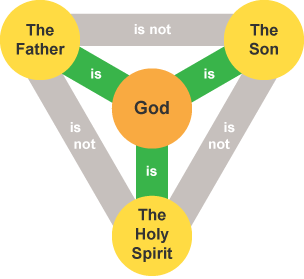
| The Father | is fully God | is not the Son | is not the Holy Spirit |
| The Son | is fully God | is not the Father | is not the Holy Spirit |
| The Holy Spirit | is fully God | is not the Father | is not the Son |
I have a scientific background, and I genuinely enjoy engaging with formulas. The image and table above reflect traditional methods, and while we may not always have personal connections with such traditions, they certainly hold a significance in our understanding of history; just ask any historian. Yet, I find myself pondering, how can one truly form a bond with a formula? I was hopeful that I was approaching a meaningful insight, but instead, it feels like I’ve merely added layers of complexity and dullness.
What I need is a more dynamic description without any words like consubstantial or perichoresis.
Still here? Not been put to sleep by the big words? I’ll continue then.
You cannot divide the Trinity. I understand that the idea of the Father as an angry god, ready to punish anyone who strays even slightly, while needing to be appeased by the loving and forgiving Son, can be troubling. However, this is not the Church’s teaching on the Trinity. The will of God is shared among all three persons of the Trinity. Jesus was sent to save us by the Father, with the empowerment of the Holy Spirit, and their motivation is love—a profound love that exists not only between them but also towards us. The words often used, such as substance or essence, refers to the nature of God. Each person of the Trinity fully embodies the complete substance of God; the Holy Spirit shares the same essence as the Father and the Son. Additionally, when we speak of “person” in this context, it doesn’t carry the same meaning as it does in our human experience; it does not imply autonomy in the way we might typically understand it.
English Puritan Thomas Watson brings this to life when he writes, “Three things may give us boldness in prayer. We have a Father to pray to, and the Spirit to help us pray, and an Advocate to present our prayers”.
The doctrine of the Trinity is best described in the Nicene Creed which says, “We believe in one God, the Father the Almighty … We believe in one Lord Jesus Christ, the only Son of God … We believe in the Holy Spirit, the Lord and giver of life.“
The Trinity also crops up in the Baptism of Jesus:
And when Jesus was baptized, immediately he went up from the water, and behold, the heavens were opened to him, and he saw the Spirit of God descending like a dove and coming to rest on him; 17 and behold, a voice from heaven said, “This is my beloved Son, with whom I am well pleased.”
Matthew 3:16-17 ESVUK
Matthew uses imagery from Genesis 1, where the Spirit hovered over the waters, and the Creator’s voice is heard at Jesus’ baptism. This highlights the Godhead’s presence, affirming that “Jesus is God.”
The dance of the Holy Trinity.
All theoretical and boring so far, but there is another idea which is relational and dynamic. The persons of the Holy Trinity are involved in a dance.
C S Lewis said:
In Christianity God is not a static thing … but a dynamic, pulsating activity, a life, almost a kind of drama. Almost, if you will not think me irreverent, a kind of dance.”
Tim Keller said**:
According to the Bible, the Father, the Son, and the Spirit glorify one another. Jesus says in his prayer recorded in John’s Gospel: “I have brought you glory on earth by completing the work you gave me to do. And now, Father, glorify me in your presence with the glory that I had with you before the world began” (John 17:4–5). Each person of the Trinity glorifies the other. It’s a dance.
The essence of dance lies in honoring, uplifting, and respecting your partner. This beautiful concept of the Holy Trinity reflecting glory upon one another through the art of dance has its roots in ancient traditions, so deeply embedded that Orthodox churches have even given it a name in Greek. It’s one of those terms I mentioned wanting to steer clear of, perichoresis. Yet, I find that “dance” captures the heart of the matter more beautifully; it’s a word that feels more accessible and relatable.
Perichoresis is used for a Greek wedding dance, but it also means to contain. In this dance, the dance of love of the Father, the Son, and the Holy Spirit, they move into each other, they belong to each other, they bring glory to each other. No one is excluded either, we are all invited to join in with the dance of God.
Now I understand why those words at the top of this post troubled me. Prayer truly is a dynamic experience, not merely a strict formula to follow. It encompasses the presence of all three persons of the Trinity, making it both vibrant and alive.
Visualisation can sometimes feel absent in our moments spent with God. Have you ever considered that your worship might be an invitation to join the dance of God? Or think about your prayers—those moments when you sit quietly, expressing your thoughts in a heartfelt tone—they are a part of that joyful dance as well.
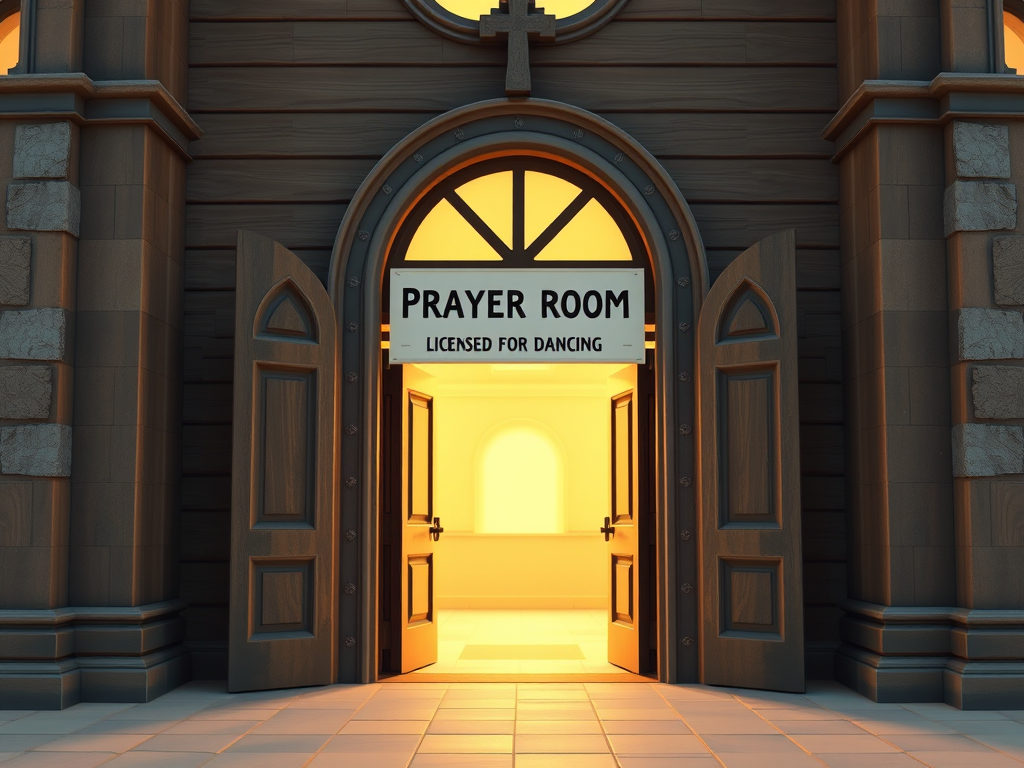
Can you imagine your church prayer meeting, just occasionally, exchanging the solemnity of intercession for dancing?
Come on, join the dance.
*Other trinitarian heresies can be found on this site.
**Keller, Timothy. King’s Cross: The Story of the World in the Life of Jesus (p. 4). John Murray Press. Kindle Edition.
 Making an ass of myself