
When did Jesus cleanse the Temple?
Who is Jesus? Part 39
This is the second section of the Cana Cycle, focusing on the temple. It’s an introduction that will be further explored in Chapter 4 when Jesus talks to a woman in Samaria. My perspective is to consider what this reveals about who Jesus is in John’s Gospel.
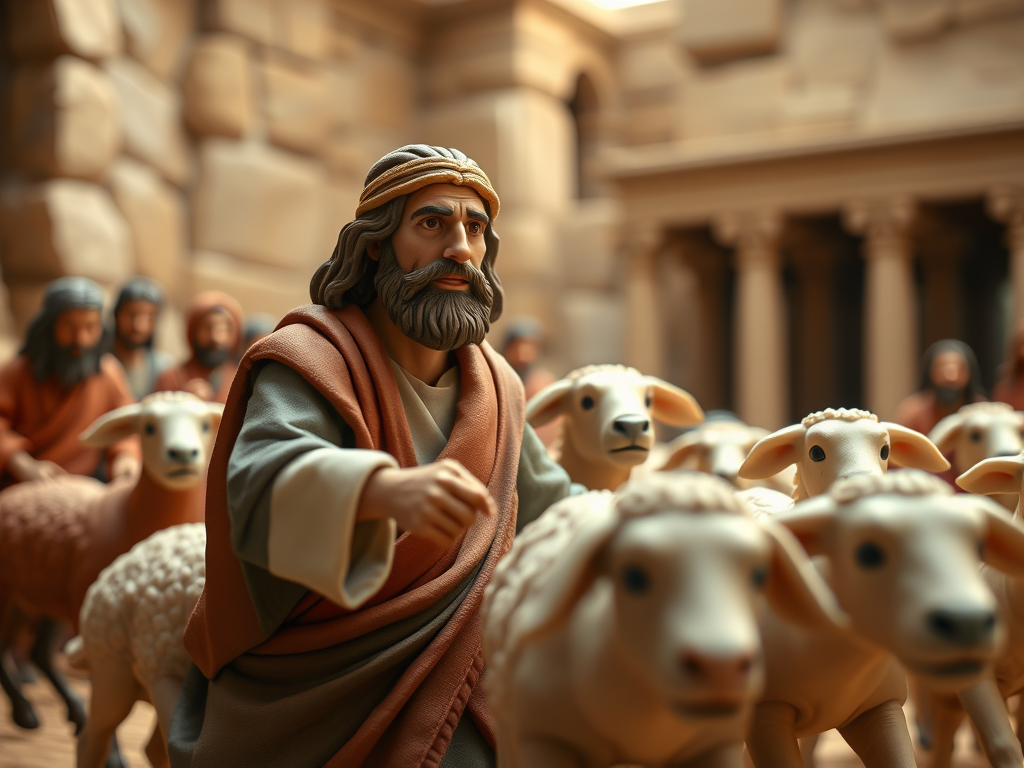
13 The Passover of the Jews was at hand, and Jesus went up to Jerusalem. 14 In the temple he found those who were selling oxen and sheep and pigeons, and the money-changers sitting there. 15 And making a whip of cords, he drove them all out of the temple, with the sheep and oxen. And he poured out the coins of the money-changers and overturned their tables. 16 And he told those who sold the pigeons, “Take these things away; do not make my Father’s house a house of trade.”
[A]17 His disciples remembered that it was written, “Zeal for your house will consume me.”
[B]18 So the Jews said to him, “What sign do you show us for doing these things?”
[X]19 Jesus answered them, “Destroy this temple, and in three days I will raise it up.”
[B’]20 The Jews then said, “It has taken forty-six years to build this temple, and will you raise it up in three days?” 21 But he was speaking about the temple of his body.
[A’]22 When therefore he was raised from the dead, his disciples remembered that he had said this, and they believed the Scripture and the word that Jesus had spoken.
John 2:12-22 ESVUK
There is a structure to these three chapters. They are one big chiasmus. Chiasm, meaning crossing over, is a poetic form used in nearly all Psalms and is a repetition of similar ideas in the reverse sequence. Where there is a central section, here marked X, that is usually the focus of the poem.
A. John 2:1-11 Miracle at Cana – Water into wine.
B. 2:12-22 Temple cleansed – new Temple of his body.
C. 2:23-3:13 We must be born from above.
X. 3:14-21 God so loved the world that He gave His Son.
C’. 3:22-4:3 Christ comes from above.
B’. 4:4-46 Temple to be replaced by a new place of worship.
A’. 4:46-54 Miracle at Cana – healing of a nobleman’s son.
There’s a similar structure in this passage. After introducing it in prose, John shifts to a poetic chiasmus with three parts:
- “The disciples remembered,”
- “The Jews said,” and
- “Jesus said.”
The first two sections are then repeated in reverse.
The central part discusses Jesus claiming he would destroy the temple, which referred to his body. I will cover that topic in next week’s post. This post focuses on other points in the passage.
When did Jesus clear the sellers out of the Temple? John mentions it at the start of his Gospel, while Matthew, Mark, and Luke place it at the beginning of the week of Jesus’ crucifixion. Did Jesus clear the temple twice? Views differ.
Yes, it happened twice
- It is traditional! It is the traditional teaching of the Roman Catholic Church, who still teach this, and this was continued by the early Protestants. Conservative Protestants still hold to two events.
- The details differ: Jesus condemns them for making the Temple a den of robbers in the synoptic Gospels, as recorded in Matthew, Mark, and Luke. In John, he condemns them for making it a house of trade. Because of this contradiction, some say, it must have been two different events.
- John will have read at least one, if not all three of the other Gospels. He adds to their accounts, suggesting there may have been multiple clearings of the Temple.
- John mentions Jesus making a whip out of several cords before entering the Temple. The synoptics do not mention a whip.
No, it happened once
- It is traditional! The Orthodox Churches say there are two versions of the same event. The Gospels tell the story of Jesus differently, to show who he is and what he did, rather than provide a full biography.
- If he cleared the Temple twice, then each Gospel writer missed it at least once; he could have done this every time he visited.
- If Jesus had committed such a bold act twice, it would be noted somewhere. The Jewish leaders might even mention it as his second offence when they oppose him for this.
It happened once, and I prefer that version, but it raises another question: Did it occur at the start of his ministry, like in John, or at the end, as in Matthew, Mark, and Luke? I aim to find the consistent parts of these accounts, and aside from Luke’s mention of Jesus visiting the Temple as a boy, all four Gospels say Jesus cleared the Temple on his first visit during his ministry. Only Mark’s account links it directly to the plot to have Jesus killed, whereas Matthew and Luke put a space between the two events.
The synoptic Gospels show Jesus starting his ministry in Galilee, then travelling to Sidon, Philippi, and the east of the Jordan to escape rising opposition, before making a final trip to Jerusalem for the last week of his life. If the Temple clearing were mentioned, it would fit their narrative to include it here. On the other hand, John could have moved it forward, his account linking the clearing of the Temple to the Cana wedding.
I understand if someone prefers a two-clearing view, a late-clearing view, or an early one. I like the early view best, but all have valid reasons for their choices.
One thing that only John mentions is that Jesus singles out the sellers of doves. Doves were an alternative sacrifice for poor people. It’s one thing to have high prices for the rich, but a bad exchange rate (The law said that sacrifices should be paid in Shekels, so money had to be changed from Greek and Roman coinage into Jewish or Tyrian Shekels), followed by an inflated price, is unfair to poor people. Who is Jesus? He is someone concerned with the plight of the poor.
Acting out a prophecy.
No matter the number or timing of the clearing of the Temple, Jesus was acting out a prophesy of the destruction of the Temple. The Temple is where God’s glory resided, but the Temple was corrupt.
This contrasts with the wedding at Cana. In John, Galilee is the region where Jesus is received, but the Jews of Jerusalem did not accept Him (cf John 1:11-12). When Jesus saw humility and faith in people, He responded (e.g. in Cana in Galilee). When met with sceptical questioning (e.g. in Jerusalem) He did not, though He spoke of His resurrection.
Wine had run out at the wedding feast, and the glory had departed from the temple, which leads on to next week’s post.
Where are we spiritually? Are we open to the Lord and ready to heed Mary’s advice, “do whatever He tells you”? Or do we come to God with a sceptical heart?
< Previous | The Gospel of John | Next >
 Making an ass of myself