
Snake on a stick
Who is Jesus? part 43 – John 3:12-21
When we had our children, we took a family holiday to Rhodes, Greece. We stayed in Lindos, in a converted fisherman’s cottage with a view of the Acropolis. The nearby beach, Saint Paul’s Bay, is named after the legend that Saint Paul landed there on his journey to Rome. A small chapel marks the spot, serving as a sanctuary for visitors.
Highlights included donkey rides to the Acropolis, sipping cocktails while people watching in the evening, and the kids’ favorite: chick sticks. These were small chicken pieces on wooden skewers that our children enjoyed like lollipops while strolling through town.
Years earlier, when our children were youngerand fewer, we stayed at another Saint Paul’s Bay in Malta, near the spot where Saint Paul was shipwrecked. Honestly, I’m not a Saint Paul stalker.
12 If I have told you earthly things and you do not believe, how can you believe if I tell you heavenly things? 13 No one has ascended into heaven except he who descended from heaven, the Son of Man.
14 And as Moses lifted up the serpent in the wilderness, so must the Son of Man be lifted up, 15 that whoever believes in him may have eternal life. 16 “For God so loved the world, that he gave his only Son, that whoever believes in him should not perish but have eternal life. 17 For God did not send his Son into the world to condemn the world, but in order that the world might be saved through him. 18 Whoever believes in him is not condemned, but whoever does not believe is condemned already, because he has not believed in the name of the only Son of God.
19 And this is the judgement: the light has come into the world, and people loved the darkness rather than the light because their works were evil. 20 For everyone who does wicked things hates the light and does not come to the light, lest his works should be exposed. 21 But whoever does what is true comes to the light, so that it may be clearly seen that his works have been carried out in God.”
John 3:14-21 ESVUK Bold and italics added by me
There is a structure to these three chapters. They are one big chiasmus. Chiasm, meaning crossing over, is a poetic form used in nearly all Psalms and is a repetition of similar ideas in the reverse sequence. Where there is a central section, here marked X, that is usually the focus of the poem.
A. John 2:1-11 Miracle at Cana – Water into wine.
B. 2:12-22 Temple cleansed – new Temple of his body.
C. 2:23-3:13 We must be born from above.
X. 3:14-21 God so loved the world that He gave His Son.
C’. 3:22-4:3 Christ comes from above.
B’. 4:4-46 Temple to be replaced by a new place of worship.
A’. 4:46-54 Miracle at Cana – healing of a nobleman’s son.
It’s not a chick on a stick that comes into this story, but a snake on a stick!
This is the core of the Cana Cycle and affects everything that follows. It has two aspects: one positive, an invitation, and one negative, a warning. I will focus on the positive aspect here and discuss the warning in the next post. I’m also approaching this in four parts, from the inside out.
Last time I wrote about the first two points:
1. that God gave himself freely for us and
2. about what believing in him means.
Those two points are the main part of this passage, which has the form of a chiasma. Chiasm, meaning crossing over, is a form used in nearly all Psalms and is a repetition of similar ideas in the reverse sequence. Though not the focus of the passage, that belongs to ‘Whoever believes in him may have eternal life. For God so loved the world, that he gave his only Son, that whoever believes in him should not perish but have eternal life,’ but it does add important context.
Here are the last two points:
The son is lifted up
This post is written in advance because it will go live the day after my wife, Linda, and I return from our holiday. In England, we refer to what you in America call your summer vacation as “holiday.” We will have visited Lanzarote, but I don’t think Saint Paul ever went to that Atlantic island.
Snake on a stick
The people complained to Moses. The history of Israel in the desert was marked by constant complaints. Now, things were different compared to when they crossed the Red Sea, although both were victories. This generation was not the same as those who refused to enter Canaan after God gave Moses the Commandments. They had wandered for 40 years in the desert, with God providing water, manna, and quails.
When the new generation grumbled to Moses, God continued to provide food and drink. They had witnessed victories over those blocking their entry to the promised land. However, when Moses chose to go around Edom, they still complained.
Now ithe Israelites were descended through Abraham, Isaac and Jacob. Edom was descended through Abraham, Isaac and Esau, Jacob’s twin. The two people’s were related.
But they complained, saying, “Why did you bring us out of Egypt to die in the wilderness? We have no food or water, and we hate this useless food.” God was taking care of them and keeping them safe, but they rejected God’s help and Moses.
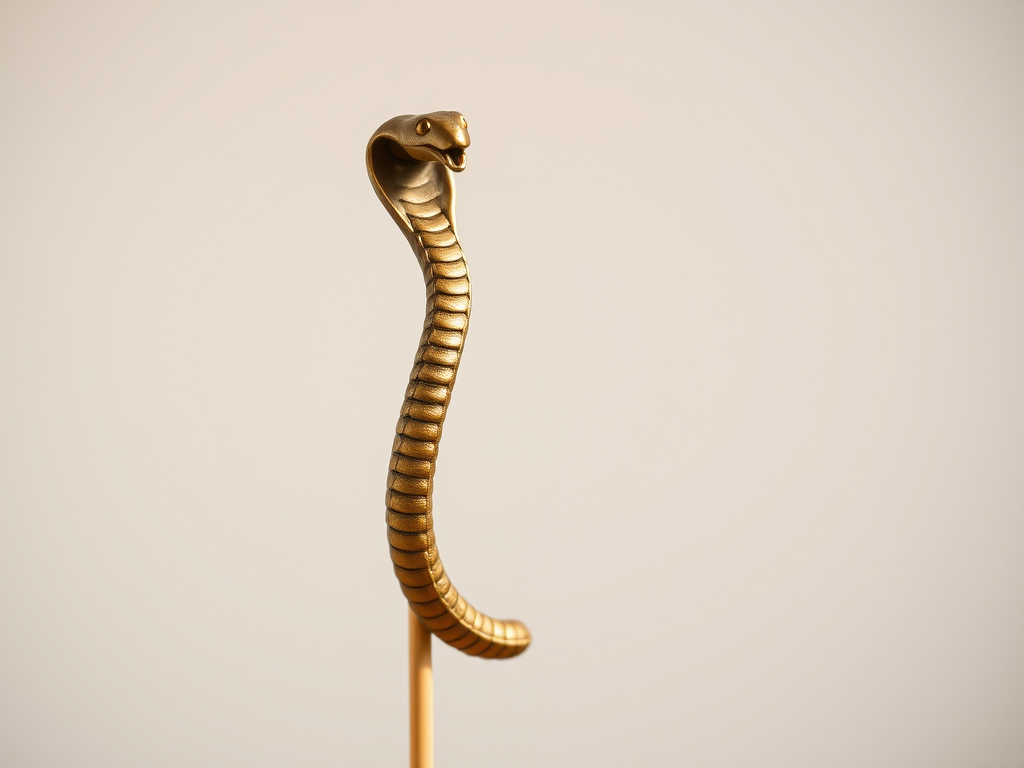
The story is in Numbers 21:5-9. The people sinned, and God offered a solution. The passage mentions that God sent venomous snakes, though it’s unclear if this was punishment or if they blamed God. The most common venomous snake in that region is the Palestine Viper, found in northern Negev, suggesting they may have taken a route through the snakes’ habitat. If you read “fiery serpents” and thought of snakes made of fire, that’s a misunderstanding. (My post picture features a cobra, which is incorrect as well, but it’s still a notable venomous snake.)
God’s way out was a snake on a stick. Moses had it made out of bronze and mounted on a pole. Anyone bitten by a snake only had to look at the bronze snake and be healed. Lesson learned the people followed Moses’ route, to the east of the Dead sea.
The fate of the snake on a stick? 700 years later the people of Judea started worsipping it as a God, and King Hezekia had it destroyed. The things that God has provided are not God and should not be worshipped.
No condemnation
Jesus compared himself to the bronze snake. He said, “And as Moses lifted up the serpent in the wilderness, so must the Son of Man be lifted up.” When the Israelites were at their worst, rejecting God, He provided the snake on a stick for their healing. Similarly, Jesus was sacrificed for our sins, even for the worst among us. God and Jesus don’t condemn us; we condemn ourselves through our actions. Even when we rebel against God, Jesus invites us to “Look at me.” Like the snake on a stick for the Israelites, Jesus on the cross represents both our rebellion and God’s immense love.
Believe in the name of the only Son of God
Light and darkness
The last part is mentioned three times, not twice. It begins with Nicodemus visiting Jesus, who didn’t trust the crowds in Jerusalem.
It serves as a pause in the conversation between Jesus and Nicodemus, where Jesus explains that although he speaks of earthly matters, he is often misunderstood. If people struggle to understand these, how can they grasp heavenly concepts? He hints at his future ascension by referring to himself as the one who came down from heaven.
Now he summarizes this teaching by returning to the start of this Gospel, discussing light and darkness, which are central themes in John’s Gospel. Why do sinners avoid Jesus’ light? Because they prefer darkness! They cling to their wrongdoings, which prevents them from stepping into the light. As a sinner gets closer to the light, their sins become more apparent. What hinders people from trusting Jesus is the moral and spiritual blindness that makes them love darkness and dislike the light.
Nicodemus may have been in darkness and unable to understand, but he turns up again at the cross. Jesus’ words must have made a big impression on him.
< Previous | The Gospel of John | Next >
 Making an ass of myself