
Guardian articles – Older autistics
Media Watch- Autism in the news
Middle-aged and older autistic individuals require improved support. An article in The Guardian published in August 2025 states that 90% of autistic people over 50 are undiagnosed.
I’m one of them.
A review of autism and ageing in the UK found that many people faced challenges with jobs, relationships, and important life events like menopause and retirement, and they often had worse mental and physical health.
Dr. Gavin Stewart, co-lead of the Re:Spect Lab at King’s College London, stated, “People often need a diagnosis, or need to recognise it within themselves, to be able to ask for appropriate help and support.” Many suffer from years of misdiagnosis, making it difficult to receive needed assistance.
Here’s an AI look at older people being diagnosed, via Microsoft Co-Pilot.
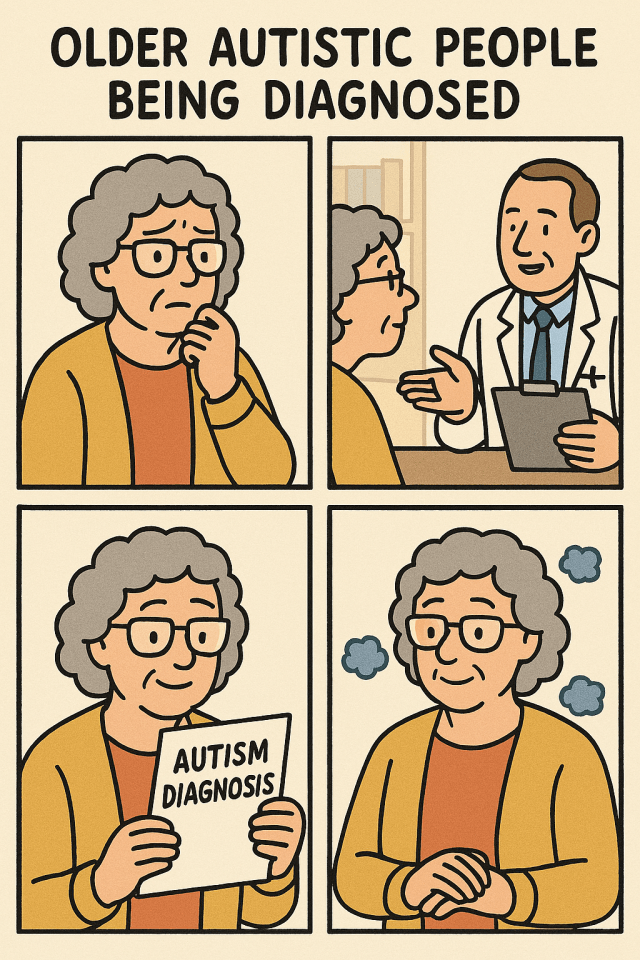
My Story:
In 2012, I was sacked because I had a meltdown at work. It took a psychologist to notice the Asperger’s syndrome, and that what I had was not an anger problem but a reaction to sensory overload and anxiety at routine being interrupted. The psychologist suggested an autism diagnosis, and my family doctor referred me. The local NHS trust informed me that there were no funds available for adult diagnosis at that time.
Nine years later, I learned it was illegal. The Equality Act 2010 states that not giving a diagnosis due to cost may be seen as not making reasonable adjustments for a disabled person.
I found a new job after 9 months. My anxiety and fear of new experiences, common in autism, kept me from entering the building for one interview I attended. I really wanted that job. The job I ended up with was in an open-plan office, which isn’t great for autistics. Even though I was offered adjustments, I didn’t know what to ask for since I hadn’t received a diagnosis.
Many people from Kirklees with a diagnosis have told me they weren’t informed about reasonable adjustments either. This helps explain why autistic adults often have poor employment records. Living without a diagnosis or receiving little support after one can greatly affect many parts of our lives.
 Making an ass of myself