
Media Watch
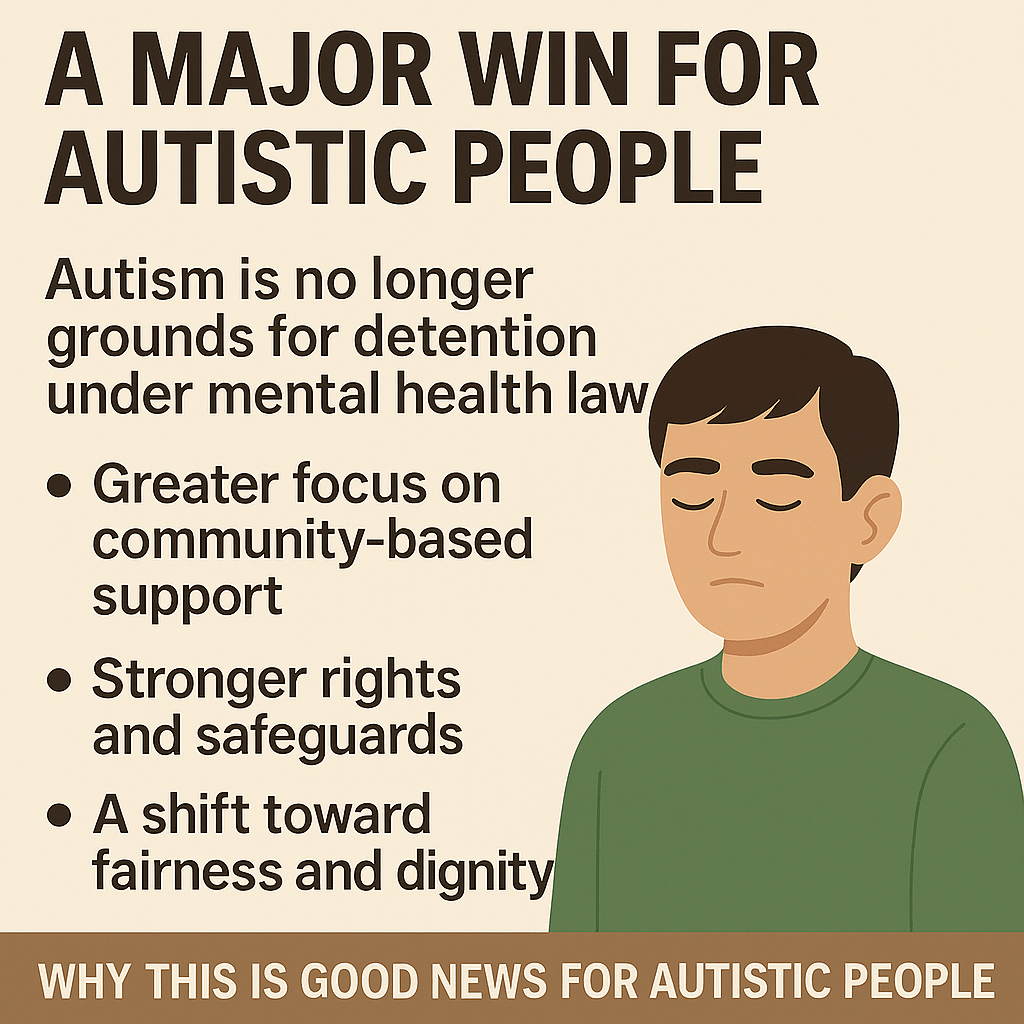
On Thursday, 18th December, the Mental Health Bill 2025 received Royal Assent and is about to become law. This has been well received by the NHS, the Royal College of Nursing and the National Autistic Society.
“It is a change long in the making,” says Tim Nicholls, former Assistant Director of Policy, Research, and Strategy at the National Autistic Society [1].
“This is a landmark moment and a vital step towards ending the inappropriate detention of people with a learning disability and autistic people in mental health hospitals, ” says Jon Sparkes OBE, Chief Executive of Mencap [2].
Autism is no longer grounds for detention
The 2025 Act aims to modernise the system, strengthen patient rights, and ensure that people are only detained when absolutely necessary.
The Mental Health Act 2025 updates the original 1983 legislation, which many experts and advocacy groups have long argued is outdated and not aligned with modern understanding of autism and learning disability. Under the old law, autistic people could be detained in mental‑health hospitals even when they did not have a mental‑health condition, leading to long, unnecessary stays in inpatient units.
The 2025 Act aims to modernise the system, strengthen patient rights, and ensure that people are only detained when absolutely necessary.
Greater focus on community‑based support
The reforms push local authorities and the NHS to provide better community services, reducing reliance on inpatient settings. This includes more personalised care plans, support closer to home and better crisis‑prevention services.
For autistic people, this means care that fits their needs rather than forcing them into unsuitable hospital environments.
Stronger rights and safeguards
The Act strengthens patient rights across the board, including more frequent reviews of detention, greater involvement of families and advocates and a clearer emphasis on patient choice and autonomy.
These changes are designed to prevent people from “falling through the cracks” and being detained without proper oversight.
A shift toward fairness and dignity
The Royal College of Psychiatrists notes that the reforms aim to make mental‑health care “fairer” and more aligned with modern understanding of developmental conditions. Autistic people often experience misunderstanding of their needs, misdiagnosis or over‑medicalisation.
The new Act explicitly seeks to correct these systemic issues.
Why This Is Good News for Autistic People
- Ends inappropriate detention: Autistic people will no longer be held in hospital simply because services don’t know what else to do.
- Encourages proper support: The law pushes authorities to provide the right kind of help: communication support, sensory‑friendly environments, and community‑based care.
- Protects human rights: The Act aligns with modern disability‑rights principles, ensuring autistic people are treated with dignity and respect.
- Reduces trauma: Long‑term hospital stays can be deeply distressing for autistic individuals. The new rules aim to prevent this harm.
[1] National Autistic Society
[2] https://www.mencap.org.uk/press-release/mencap-responds-royal-assent-mental-health-bill
 Making an ass of myself
I’m so glad this has happened. Human Rights is more than just something needed to happen in foreign lands (sic). I’m reminded that when Jesus spoke of going to the four corners of the world, that from Roman Palestine/Israel most of us live in those four corners. This is not a normal worldview, but it is a kingdom view.
My son has a condition similar to autism because he was given medication at a young age that was actually contraindicated on several items of concern by the PDR; available to be used in the USA, but only when doctors actually pick it up and examine it for education regarding the patient.
Yea for folks who’ve been discriminated against and now have available more safeguards.
Thanks be to God.