
What is meant by the Sabbath?
Who is Jesus? part 55 – John 5:1-18
Noah’s Ark is a toy now most often seen in museums. The popularity of this toy is that, because it was based on the Bible, it was the only toy a child would be allowed to play with on a Sunday. I am not old enough to remember this restriction, nor was I brought up in a strict religious family, so I was able to play my way through the weekend.
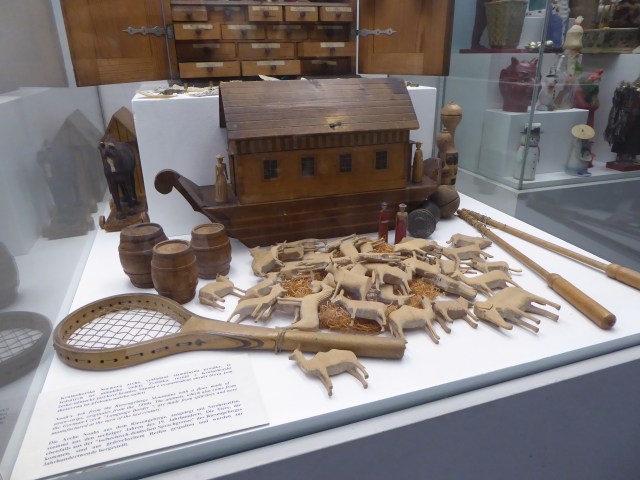
Picture from Wikimedia Commons.
A: 5 After this there was a feast of the Jews, and Jesus went up to Jerusalem. 2 Now there is in Jerusalem by the Sheep Gate a pool, in Aramaic called Bethesda, which has five roofed colonnades. 3 In these lay a multitude of invalids—blind, lame, and paralysed.
B: 5 One man was there who had been an invalid for thirty-eight years. 6 When Jesus saw him lying there and knew that he had already been there a long time, he said to him, “Do you want to be healed?”
C: 7 The sick man answered him, “Sir, I have no one to put me into the pool when the water is stirred up, and while I am going another steps down before me.”
D: 8 Jesus said to him, “Get up, take up your bed, and walk.”
E: 9 And at once the man was healed, and he took up his bed and walked.
X: Now that day was the Sabbath. 10 So the Jews said to the man who had been healed, “It is the Sabbath, and it is not lawful for you to take up your bed.”
E’:11 But he answered them, “The man who healed me, that man said to me, ‘Take up your bed, and walk.’”
D’: 12 They asked him, “Who is the man who said to you, ‘Take up your bed and walk’?”
C’: 13 Now the man who had been healed did not know who it was, for Jesus had withdrawn, as there was a crowd in the place.
B’: 14 Afterwards Jesus found him in the temple and said to him, “See, you are well! Sin no more, that nothing worse may happen to you.”
A’: 15 The man went away and told the Jews that it was Jesus who had healed him. 16 And this was why the Jews were persecuting Jesus, because he was doing these things on the Sabbath. 17 But Jesus answered them, “My Father is working until now, and I am working. 18 This was why the Jews were seeking all the more to kill him, because not only was he breaking the Sabbath, but he was even calling God his own Father, making himself equal with God.
John 5:1-18 ESVUK Paragraphs have been altered to show the poetic structure and bold italics show the theme of each part.
The Gospel according to John, chapter 5, has similarities to chapter 1 in that it is made up of three passages in the form of chiasms or chiasmus. Chiasm, meaning crossing over, is a form used in nearly all Psalms and is a repetition of similar ideas in the reverse sequence. For this reason, I am referring to these sections as songs, as I did with chapter 1.
-o0o-
I once made a mistake when calling my sister. I calculated the time difference between West Yorkshire, UK, where I live, and British Columbia, where she lives. Instead of calling her in the morning, I woke her up in the early hours. I’m not surprised she didn’t want to talk.
Baker Pru Leith made the same mistake during her first year as a judge on The Great British Bake Off by congratulating the winner on social media too early, before the episode aired. She quickly deleted the post and apologized, saying, “I am so sorry to the fans of the show for my mistake this morning; I am in a different time zone and mortified by my error.”
Jesus and the Judeans operated on different schedules: The Judeans followed a seven-day week with a Sabbath on the seventh day, when they rested from work. However, they lacked a clear definition of work, so they prohibited various activities to avoid any doubt. John’s Gospel features seven signs, each relating to the days of creation. This was the third sign, corresponding to Jesus’ third working day. His day of rest is still to come.
The issue of Jesus healing on the Sabbath appears in the synoptic Gospels as well. He said, “The Sabbath was made for people, not people for the Sabbath” (Mark 2:27). Genesis states that the Sabbath is the day after humans were created. It is the seventh day for God but the first full day for people. We need to rest in order to work effectively.
One of the main focuses of John’s Gospel is who Jesus is, but the focus here changes to the healed man. All Jesus had done was say, “Take up your bed and walk.” How could that have been considered work? The man then did as he was told, and then found that carrying his bed was considered work. How dare he be healed on the Sabbath? His defense is that it was things done to him, not things he did.
There is a distinction in the Greek of John’s Gospel that does not show up in the ESV Anglicised translation I mainly use, between Judeans and Jews. Jesus and the healed man are Jews, but John uses Judeans to distinguish the people of Jerusalem from other Jews.
God was making a new creation, and Jesus was bringing that creation in. Jesus is the fulfillment of the Sabbath; he wasn’t breaking God’s law but demonstrating its true, compassionate intent. By giving people rest, the Sabbath was meant to bring life. There is a big difference between work and doing things that bring enjoyment.
So what does this say about Jesus? He is the fulfillment of the Law, even the commandments. He shows what the law is supposed to do, which is not to grind people down but to show them that they can’t keep rules and send them to God who loves and cares for them. He said, “the Son of Man is Lord of the Sabbath.” Matthew 12:8.
The story of the healed man doesn’t start well. He is waiting at a pagan site, which had been dedicated to the Greek healing demigod Asclepius, still hoping for a chance at healing after 38 years.
It doesn’t end well either. He has a less-than-friendly interview with the Jewish authorities, and after meeting Jesus again, instead of being thankful to God or to Jesus, he rats on Jesus to the authorities. Doing the right thing can lead to not only misunderstanding but to downright opposition. The road to the cross takes another step, the Judeans wanting to get rid of by any means the very one they claim to worship.
< Previous | The Gospel of John | Next >
 Making an ass of myself