
Disabled Jesus, part 1c
The Disabled God and Pain – Solidarity part 3
I almost left church, even though it had been praying for me when I was in the hospital and near death. Then I fell into depression. When I shared my feelings, I often heard, “If you are feeling far from God, guess who moved?” I didn’t fit the typical image of a Christian, and I’ve never felt like I did. The church accepts physical pain, but emotional pain from depression is less understood.
But Jesus experienced emotional and spiritual pain.
22 And they brought him to the place called Golgotha (which means Place of a Skull). 23 And they offered him wine mixed with myrrh, but he did not take it. 24 And they crucified him and divided his garments among them, casting lots for them, to decide what each should take. 25 And it was the third hour when they crucified him. 26 And the inscription of the charge against him read, “The King of the Jews.” 27 And with him they crucified two robbers, one on his right and one on his left. 29 And those who passed by derided him, wagging their heads and saying, “Aha! You who would destroy the temple and rebuild it in three days, 30 save yourself, and come down from the cross!” 31 So also the chief priests with the scribes mocked him to one another, saying, “He saved others; he cannot save himself. 32 Let the Christ, the King of Israel, come down now from the cross that we may see and believe.” Those who were crucified with him also reviled him.
33 And when the sixth hour had come, there was darkness over the whole land until the ninth hour. 34 And at the ninth hour Jesus cried with a loud voice, “Eloi, Eloi, lema sabachthani?” which means, “My God, my God, why have you forsaken me?” 35 And some of the bystanders hearing it said, “Behold, he is calling Elijah.” 36 And someone ran and filled a sponge with sour wine, put it on a reed and gave it to him to drink, saying, “Wait, let us see whether Elijah will come to take him down.” 37 And Jesus uttered a loud cry and breathed his last. 38 And the curtain of the temple was torn in two, from top to bottom. 39 And when the centurion, who stood facing him, saw that in this way he breathed his last, he said, “Truly this man was the Son of God!”
Mark 15: 22-39 ESVUK
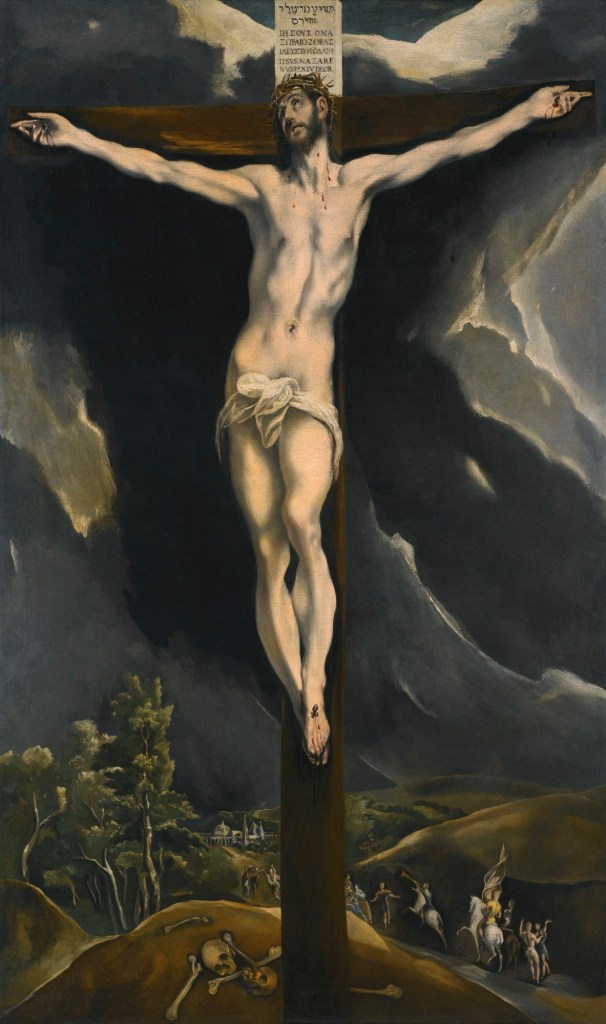
The four evangelists cover the crucifixion is different ways:
Mark:
Mark presents Jesus as the suffering servant who feels intense abandonment and pain, ultimately crying out in despair at his death. “My God, my God, why have you forsaken me?” Jesus’ spiritual pain is revealed.
Matthew:
Matthew’s account is like Mark’s but focuses on different things. Matthew stresses fulfilled prophecies, while Mark points out suffering and immediate actions.
Luke:
Luke’s story of Jesus not only shows his suffering like Mark does but also emphasizes his compassion and feelings. For example, while on the cross, Jesus asks God to forgive his executioners. Luke also notes that Jesus experienced such intense mental anguish in the Garden of Gethsemane that his sweat became like great drops of blood (hematidrosis).
John:
John’s account is unique. He highlights Jesus’ divinity and control over his fate, even at the crucifixion. It’s the only account where Jesus entrusts his mother to the beloved disciple. John’s account of Jesus’ suffering also parallels a coronation as a king.
-o0o-
What I want to dwell on here is found in all the accounts, it is solidarity with pain. We can find comfort in a Saviour who understands the emotional, mental, and physical pain of living with a body that is restricted or in pain. This breaks down the unfortunate idea that impairment is a sign of sin or divine punishment.
I believe in a Jesus who walks beside me and takes my pain into his own. Suffering gives me an insight into Jesus, I have companionship in pain. The crucifixion reveals that God does not simply look down on human suffering from a distance but enters into it. Jesus experienced the maximum possible physical, emotional, and spiritual pain, making him a man who deeply understands human suffering.
< previous | The Passion of Jesus through the eyes of disability | next >
 Making an ass of myself
During Lent, this is especially poignant for my wife and me in our RCL daily readings and our living conversation of faith. Btw, we believe we’ll be continuing that conversation not only here, but on the other side of Eternity.
The Jewish people refined the art of blaming the victim in their Traditions of the Fathers. Jesus countered that with facts, as recorded in our Gospels. Christians today still carry that attitude, intentionally or inadvertently (the latter perhaps is a quick quip as you wrote, which I think is in line with over 50 years of exposure to positivism tracing back for our purposes to Psycho Cybernetics in the 1920’s at least in the USA) and it is even in line with hearing the completely false quote “God helps them that help themselves”. Ugh, it came from ancient Greece, found in two Aesop’s Fables.
Thank you for enriching our mind and encouraging us in our faith. You press on others the need to be examining God’s self-revelation in Scripture and Jesus our Lord.
sincerely,
your fellow suffering-servant.
In the town where I live, Huddersfield England, the town motto is “Juvat Inpigros Deus” meaning “God helps the diligent,” or “God helps the industrious,” popularly translated as, “God helps those who helps themselves.” Although this motto has not had oficial status since the local government reorganisation in the 1970, it can still be seem on places where the old town crest is displayed, including on park benches.
I was unaware this motto originated in Aesop, but was aware that it was popularised un the UK by Algernon Sidney, a man who was executed for treason. My understanding of God’s justice is that it includes a bias towards widows, orphans, the poor and foreigners; the opposite of what that slogan says.
In Aesop’s Fable which I read, the end line in English is “the gods help them that helps themselves.”
You are right, it is a fable, false teaching. God’s reality is so much more better.
It is hard to dispel cultural beliefs inside ourself or the church. We keep intentionally seeking Holy Spirit to work through us, if it pleases the Father and the Son.
Peace in Him.
out.