
Disabled Jesus, part 2b
Disability as Identity: Wholeness Part 2
I have already mentioned that I have been prayed over to cast out an anger demon. I now understand that I am autistic and have meltdowns for complex reasons, mostly sensory ones like sudden loud noises and bright lights. These meltdowns are not anger, but are often misunderstood that way. The anger demon did not come out because it was never there in the first place. Anger management treatment also didn’t work, because it was not anger.
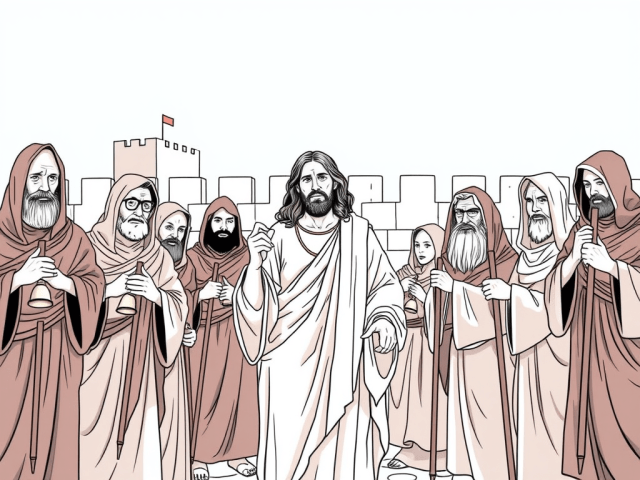
Here’s a story about Jesus:
11 On the way to Jerusalem he was passing along between Samaria and Galilee. 12 And as he entered a village, he was met by ten lepers, who stood at a distance 13 and lifted up their voices, saying, “Jesus, Master, have mercy on us.” 14 When he saw them he said to them, “Go and show yourselves to the priests.” And as they went they were cleansed. 15 Then one of them, when he saw that he was healed, turned back, praising God with a loud voice; 16 and he fell on his face at Jesus’ feet, giving him thanks. Now he was a Samaritan. 17 Then Jesus answered, “Were not ten cleansed? Where are the nine? 18 Was no one found to return and give praise to God except this foreigner?” 19 And he said to him, “Rise and go your way; your faith has made you well.”
Like 17:11-19
Disability as Identity:
Rather than looking forward to a heaven where all disabilities are removed, some disabled Christians find hope in the idea that their disabled identity, and therefore their true selves, will be honoured in the resurrection, just as Jesus’ wounds were part of his glorified body.
Two theologians I have read who claim to have disabilities have different opinions. One believes that she will still be disabled in heaven, the other sees heaven as the place where his disabilities will end. It all comes down to the question, “Do you identify as being disabled or see disability as something other than you?”
I am an autistic man. I identify as autistic because my brain is wired differently; that’s what neurodiversity is. If autism were taken away, I’d be a different person, so I identify. As for disability, it is more nuanced. I was not born with arthritis, or diabetes or a torn shoulder or a hernia. Not all disabilities are visible. You can see the results of my arthritis, which is in my left foot and causes me to walk on crutches to alleviate the pain. But diabetes is more debilitating; it saps energy and leaves me too tired to do much physically. In both cases, I say I’m a disabled man. I have exercises for a partly torn shoulder and have had an operation for a hernia, both of which affect what I do to some extent, though I refer to them as something I have.
Jesus’ healings are proof of what lies at the heart of the Gospel. This is what says to the sick and disabled and all who are excluded and marginalised, “there are no outsiders. All are included.” The healings are radical acts of inclusion. The lepers in the Bible reading above were cast out of society. When Jesus healed them, he gave them access back into society. The healing of Jesus gave them access to inclusion.
But there’s also a sense here that the physical cure was not a complete healing, only the man who returned in praise and thankfulness heard the words, “your faith has made you well.”There is something here, wholeness, which is more than a medical cure.
Look at this event:
2 And behold, some people brought to him a paralytic, lying on a bed. And when Jesus saw their faith, he said to the paralytic, “Take heart, my son; your sins are forgiven.” 3 And behold, some of the scribes said to themselves, “This man is blaspheming.” 4 But Jesus, knowing their thoughts, said, “Why do you think evil in your hearts? 5 For which is easier, to say, ‘Your sins are forgiven,’ or to say, ‘Rise and walk’? 6 But that you may know that the Son of Man has authority on earth to forgive sins,”—he then said to the paralytic—“Rise, pick up your bed and go home.” 7 And he rose and went home. (Matthew 9:2-7)
Here it’s the other way round. The spiritual healing was what mattered most here. That comes when Jesus says, “Your sins are forgiven.” It is only as a demonstration to his distractors that he says, “Rise, pick up your bed and go home.” A physical cure does not seem to be Jesus main priority here. (Please note that it doesn’t say that sin was the cause of the paralysis here. If it was, wouldn’t the man have been phyically head at that point.)
As for me, I look forward to that time when my scars will be glorified in heaven as Jesus scars were.
< previous | The Passion of Jesus through the eyes of disability | next >
 Making an ass of myself