
Disabled Jesus, part 3a
The Power of Vulnerability: Subverting Power Dynamics Part 1
The coronation of Charles III in May 2023 was a grand televised event watched worldwide, though some parts were held behind a curtain. The guest list included former Prime Ministers and heads of state. There was also representation from the Roman Catholic Church, Orthodox churches, and Free Churches, all participating in the ceremony. Leaders from other faiths attended at the king’s request. It was one of the most extravagant events I have ever seen.
There is a very different coronation in the Gospel according to St. John:
19 Then Pilate took Jesus and flogged him. 2 And the soldiers twisted together a crown of thorns and put it on his head and arrayed him in a purple robe. 3 They came up to him, saying, “Hail, King of the Jews!” and struck him with their hands. 4 Pilate went out again and said to them, “See, I am bringing him out to you that you may know that I find no guilt in him.” 5 So Jesus came out, wearing the crown of thorns and the purple robe. Pilate said to them, “Behold the man!” 6 When the chief priests and the officers saw him, they cried out, “Crucify him, crucify him!” Pilate said to them, “Take him yourselves and crucify him, for I find no guilt in him.” 7 The Jews answered him, “We have a law, and according to that law he ought to die because he has made himself the Son of God.” 8 When Pilate heard this statement, he was even more afraid. 9 He entered his headquarters again and said to Jesus, “Where are you from?” But Jesus gave him no answer. 10 So Pilate said to him, “You will not speak to me? Do you not know that I have authority to release you and authority to crucify you?” 11 Jesus answered him, “You would have no authority over me at all unless it had been given you from above. Therefore he who delivered me over to you has the greater sin.”
16 So he delivered him over to them to be crucified. So they took Jesus, 17 and he went out, bearing his own cross, to the place called The Place of a Skull, which in Aramaic is called Golgotha. 18 There they crucified him, and with him two others, one on either side, and Jesus between them. 19 Pilate also wrote an inscription and put it on the cross. It read, “Jesus of Nazareth, the King of the Jews.” 20 Many of the Jews read this inscription, for the place where Jesus was crucified was near the city, and it was written in Aramaic, in Latin, and in Greek. 21 So the chief priests of the Jews said to Pilate, “Do not write, ‘The King of the Jews’, but rather, ‘This man said, I am King of the Jews.’” 22 Pilate answered, “What I have written I have written.”
John 19:1-11, 16-22 ESVUK
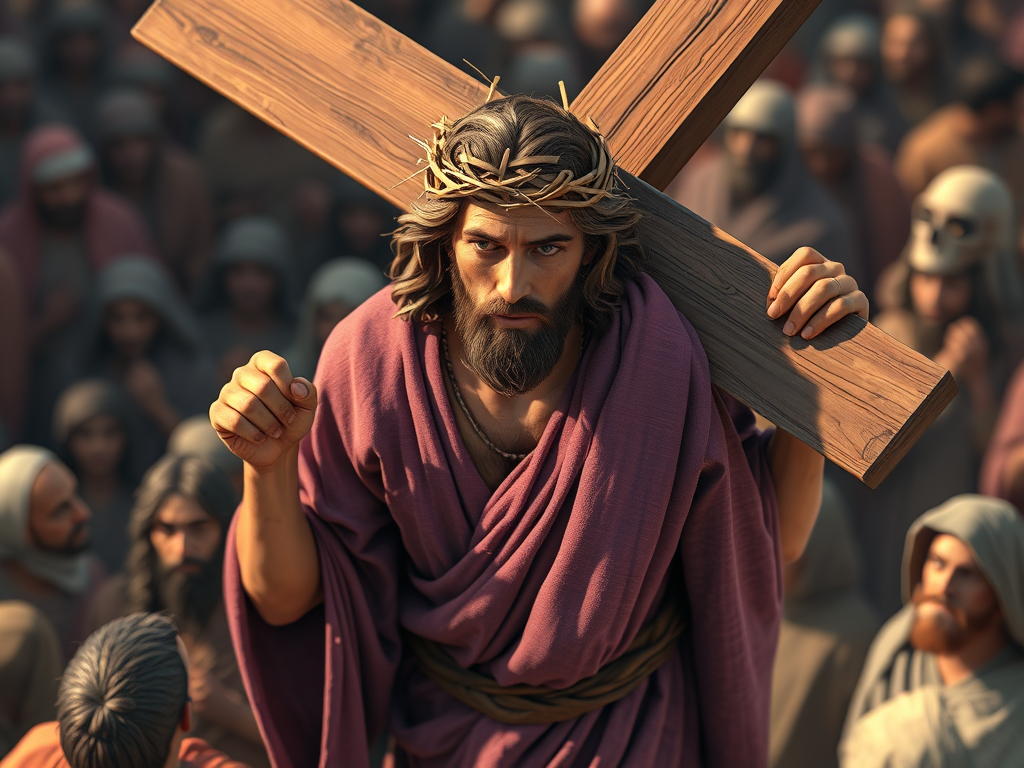
The Power of Vulnerability:
John’s version of the crucifixion is extaordinary. It shows that all the way through the story, from the arrest through the trial before the high priests and of Pontius Pilate through to his torture and execution, Jesus was in control of what was happening. The second extraordinary thing is the story is that of Jesus’ crucifixion was his coronation.
Coronations are not humble, unexpected, unplanned, unofficial, spontaneous, superficial, or temporary. This list is from an article explaining why the crucifixion of Jesus was not a coronation. According to John, Jesus’ coronation reflects all seven qualities of a typical coronation, but John uses irony, modeling it after the coronation of an Emperor.
- Caesar wore a purple robe, held a sceptre, and was crowned with laurel.
Jesus wore purple, held a reed, and was crowned with thorns. - A guard of soldiers surrounded both men, acclaiming Caesar, but mocking Jesus. Both were paraded through the streets
- During the Triumph ritual the Roman Emperor would have been announced as “Son of God.”
The legend on Jesus’ cross read, “Jesus of Nazareth, the King of the Jews.”
The image of Christ on the cross changes our understanding of power. God is shown not through strength, but in the vulnerability of a broken body. John used Roman language to declare Jesus as the true King. This reversal presents Jesus not just as King of the Jews, but as the King of the world, achieving this in humility, without the power struggles of Roman or British coronations.
To disrupt the coronation this way, John demonstrates that true greatness in God’s Kingdom comes from becoming humble and serving others.
Looking at Jesus, our crucified King, from the view of a disabled person, I see a king who understands suffering. He empathizes with our struggles because he has faced them as well. Our broken disabled bodies find comfort in his. This week I will celebrated, if that is the right word, the 20th anniversary of my being disabled. It changed the way I thought about Jesus and totally changed the way I look at the church. Yet I’m still here.
< previous | The Passion of Jesus through the eyes of disability | next >
 Making an ass of myself