
Disabled Jesus, part 4a
Re-reading the Healing Narratives Part 1
Social Restoration over Physical Fix
Chronic pain is difficult, even when it isn’t intense. One of my disabilities is osteoarthritis in my ankle, which requires me to use crutches. I can walk with one crutch or a walking stick, and I often do, but that causes more pain and makes me slower. There’s a term, ombrosalgia, which comes from Greek words meaning “rain pain.” Rain makes my arthritic joint hurt more, especially when the weather is cold and wet. I call it rain pain because I like the way it rhymes.
Living with pain makes me read the healing miracles of Jesus in a new light.
29 And immediately he left the synagogue and entered the house of Simon and Andrew, with James and John. 30 Now Simon’s mother-in-law lay ill with a fever, and immediately they told him about her. 31 And he came and took her by the hand and lifted her up, and the fever left her, and she began to serve them.
32 That evening at sundown they brought to him all who were sick or oppressed by demons. 33 And the whole city was gathered together at the door. 34 And he healed many who were sick with various diseases, and cast out many demons. And he would not permit the demons to speak, because they knew him.
35 And rising very early in the morning, while it was still dark, he departed and went out to a desolate place, and there he prayed. 36 And Simon and those who were with him searched for him, 37 and they found him and said to him, “Everyone is looking for you.” 38 And he said to them, “Let us go on to the next towns, that I may preach there also, for that is why I came out.”
Mark 1:29-38
I’m looking at the passion of the Christ from the perspective of Trauma theology. During Lent this year I celebrated, if that is the right word, the 20th anniversary of my being disabled.
Through the eyes of the disabled, the Passion is a powerful, intimate, and comforting story of a God who is not distant from, but deeply immersed in, the experience of vulnerability.
Social Restoration over Physical Fix: When viewed from a disability justice perspective, Jesus’ healing miracles are often seen less as “fixing” a broken body and more as acts of social re-integration, restoring dignity to those excluded from community life.
The passage above is in two very contrasting parts.
1. The healing of Peter’s Mother-in-Law
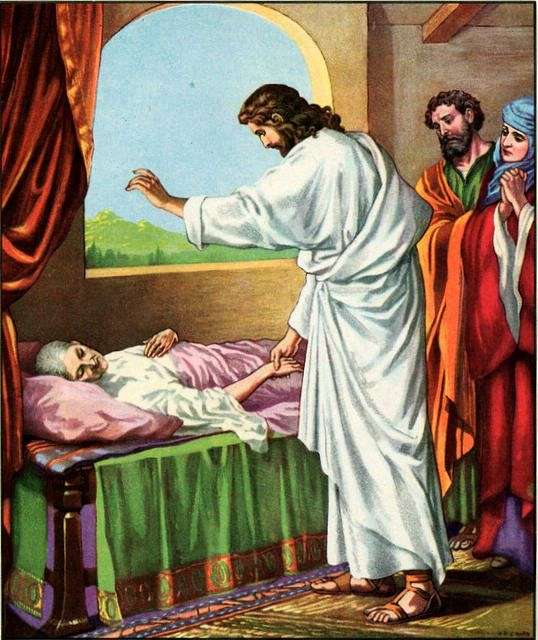
What I liked about the illustration I chose is that Peter’s wife, assumed but not mentioned in the accounts of Matthew, Mark and Luke, has been included.
Jesus often healed people by touching them, including lepers, whom the law prohibited touching due to fears of disease. Anyone who touched them would be considered unclean. Although the text does not specify that Peter’s mother-in-law had leprosy, is she had it it would have been mentioned, it does mention Jesus taking her hand, which shows his care, and lifting her up. There is no record of Jesus speaking, but she was healed and able to prepare food right away. With Jesus things work the other way round, instead of Jesus becoming unclean from his touch or Jesus becomeing unwell, instead the touch of Jesus conveys his wholeness and health on the other person.
This was the Sabbath and although Jesus had just cast an unclean spirit out of a man in the synagogue, he is careful to heal privately. He will later heal openly on the Sabbath, but not yet.
2. Leaving for other towns
The crowds came at sundown. The Sabbath lasted for a Jewish day, from one sunset to the next, so this was no longer the Sabbath and Jesus heals all that come to him.
What used to trouble me is what comes the next morning. Jesus gets up early. If Jesus always got up early it is unlykely Mark would have included it in his account. So what makes it special? Jesus is mentioned getting up early to pray a few times, such as when he chose the disciples. These are the turning points in his ministry.
Jesus had to spend time with his Father, was this time to move on to a new stage in his ministry? He could have stayed in Capernaum and been a healer, who knows, that could have been lucrative. But that was not part of his plan. The plan was always to annouce the arrival of the Kingdom of God.
Jesu did not come to be a healer. That was just one part of announcing the Kingdom. When Simon and the others found him, Jesus mind was made up. The next phase of his ministy had begun, that of being a wandering teacher and prophet around the towns of Galilee.
So Jesus stopped trying to heak everyone. More crowds were forming in the Caperneum streets, presumably bringing their sick relatives and freinds with them as the previous evening’s crowd had done. But Jesus had a different mission, anouncing that the kingdom of God had come on earth. There would still be healings of individuals, as evidence that the power of God was in Jesus, most of these were about restoring people back into soceity, lepers clensed, a widow’s only sone restored to life, but the mass healings were no more.
Jesus’ care for us is not just about healing. It is about restoration of people in the sight of God but also to their place in society — Justice is for the outcast as well as the respectable people.
< previous | The Passion of Jesus through the eyes of disability | next >
 Making an ass of myself