
Disabled Jesus, part 4b
Re-reading the Healing Narratives Part 2: A Critique of Healing Culture
This is the last in my Lenten season of reflective posts. I’m leaving Holy Week free, except for a Good Friday.
Does your church have room for wheelchairs? Assuming they can get up the front steps, then what? Fixed pews do not give them a lot of choice: Blocking the aisle, in a seat where they are stuck as their way if moving is removed or on their own in front of the pews. It’s not a good choice and it needs fixing.
Jesus was in a place where entry was difficult:
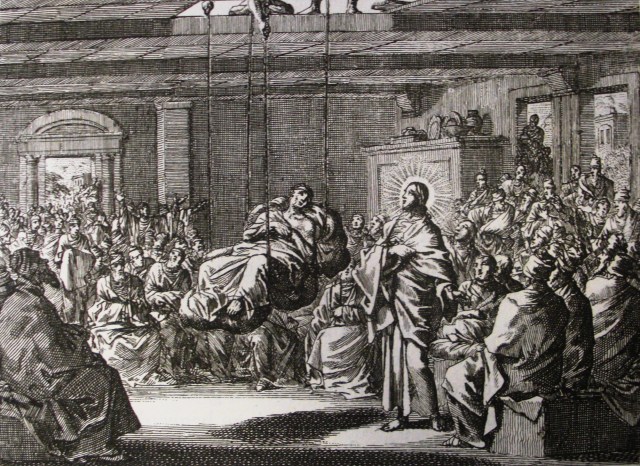
And when he returned to Capernaum after some days, it was reported that he was at home. 2 And many were gathered together, so that there was no more room, not even at the door. And he was preaching the word to them. 3 And they came, bringing to him a paralytic carried by four men. 4 And when they could not get near him because of the crowd, they removed the roof above him, and when they had made an opening, they let down the bed on which the paralytic lay. 5 And when Jesus saw their faith, he said to the paralytic, “Son, your sins are forgiven.” 6 Now some of the scribes were sitting there, questioning in their hearts, 7 “Why does this man speak like that? He is blaspheming! Who can forgive sins but God alone?” 8 And immediately Jesus, perceiving in his spirit that they thus questioned within themselves, said to them, “Why do you question these things in your hearts? 9 Which is easier, to say to the paralytic, ‘Your sins are forgiven’, or to say, ‘Rise, take up your bed and walk’? 10 But that you may know that the Son of Man has authority on earth to forgive sins”—he said to the paralytic— 11 “I say to you, rise, pick up your bed, and go home.” 12 And he rose and immediately picked up his bed and went out before them all, so that they were all amazed and glorified God, saying, “We never saw anything like this!”
Mark 2:1-12 ESVUK
During Lent this year I celebrated, if that is the right word, the 20th anniversary of my being disabled.
Critique of “Healing” Culture:
Many disabled individuals challenge the constant demand for physical healing within churches, suggesting that this can imply their lives are not worth living unless they are made “normal.” The Disabled Christ validates their current, real-life experience.
Through the eyes of the disabled, the Passion is a powerful, intimate, and comforting story of a God who is not distant from, but deeply immersed in, the experience of vulnerability.
The Bible passage shows poverty. Good houses never had mud roofs that could be broken through. The presence of the Scribes was an issue, as they could cancel debts but required the tithe and Temple tax to be paid. This, along with Roman taxes, as taxes could be higher than income, could cause people to lose their homes, even those with mud roofs that could be harmed by rain.
The term “sins” can also mean “debts.” When Jesus says, “your sins are forgiven,” he highlights what the scribes were meant to do. This is why Jesus faced opposition for doing good works, as he was acting where they should have.
Ched Myers, an activist and theologian, discusses this in “Binding the Strongman: A Political Reading of Mark’s Story of Jesus:”
Disease and physical disability were an inseparable part of the cycle of poverty….For the day laborer illness meant unemployment and instant impoverishment… Economic and political deterioration, especially in the decade prior to the upheavals of the Roman-Jewish war [A.D. 66-70], had dispossessed significant portions of the Palestinian population, especially in the densely populated rural areas of Galilee.
And concludes:
Jesus’ healing ministry is thus portrayed as an essential part of his struggle to bring concrete liberation to the oppressed and marginal of Palestinian society.
But that is a social justice reading of Mark. It shows how a passage can be read different ways and still be valid. I have nothing against social justice readings ot the Bible, it is there and should not be ignored, but there’s more to the Bible than that one reading. I’m looking for a disabled theology.
Professor Francis Davis, Professor of Religion, Communities and Public Policy at the University of Birmingham during the COVID lockdown, told a Zoom conference on Catholic Social Teaching, that the Church always assumed that it treated disabled people better than the secular world. But the reality is that its track record is really poor. “Fifteen per cent of the world’s population lives with a serious life affecting disability,” he said. “That’s a huge and growing part of the community that does not find representation within or is served by the Church, which instead sees them as impaired and views them as objects.”
Davis pointed out that the Church continues to see disabled people as different. He cited the lack of people with any disability in senior roles, with no bishop with a visible named disability in any episcopal denomination within English-speaking countries.
Why do the churches, any churches, look on us, people with disabilities and neurodivergence, as a problem to be fixed? They could have looked on us a different way, not as a pastoral problem, but as a prophetic potential.
Many physical and learning-disabled people have wisdom that comes through their lived experience of social oppression, not in-spite of it. They have gained this wisdom from being marginalised to the edges of churches, and from which the Church which could have benefited so much from them. The Church is impoverished by its own neglect.
We want help from people who ask us what we need. Thank you for your good intentions, and thank you for listening. What you hear may be confusing; for example, someone like me with light sensitivity needs less light, while someone with partial sight may need more. I use dark glasses and prefer dimmer light because I get dazzled easily, like in most libraries. But that’s my circumstance, others differ. Just ask the people using your facilities for their needs.
< previous | The Passion of Jesus through the eyes of disability | next >
 Making an ass of myself