
Departing
Who is Jesus? part 71 – John 6:60-71
That’s me in the corner
That’s me in the spotlight, losing my religion
(Peter Buck / Michael Mills / William Berry / Michael Stipe Copyright Night Garden Music 1991)
Hey, that’s me there in the corner, my head upon my hands
Or maybe I’m the one who’s trying to smile
(Adrian Snell 1978)
Two songs that talk about depression. The REM song Losing My Religion is probably about depression rather tan actual loss of religion but the earlier Adrian Snell song is definitely about that, as well as depression.
This section of John’s Gospel is when Jesus lost his crowd.
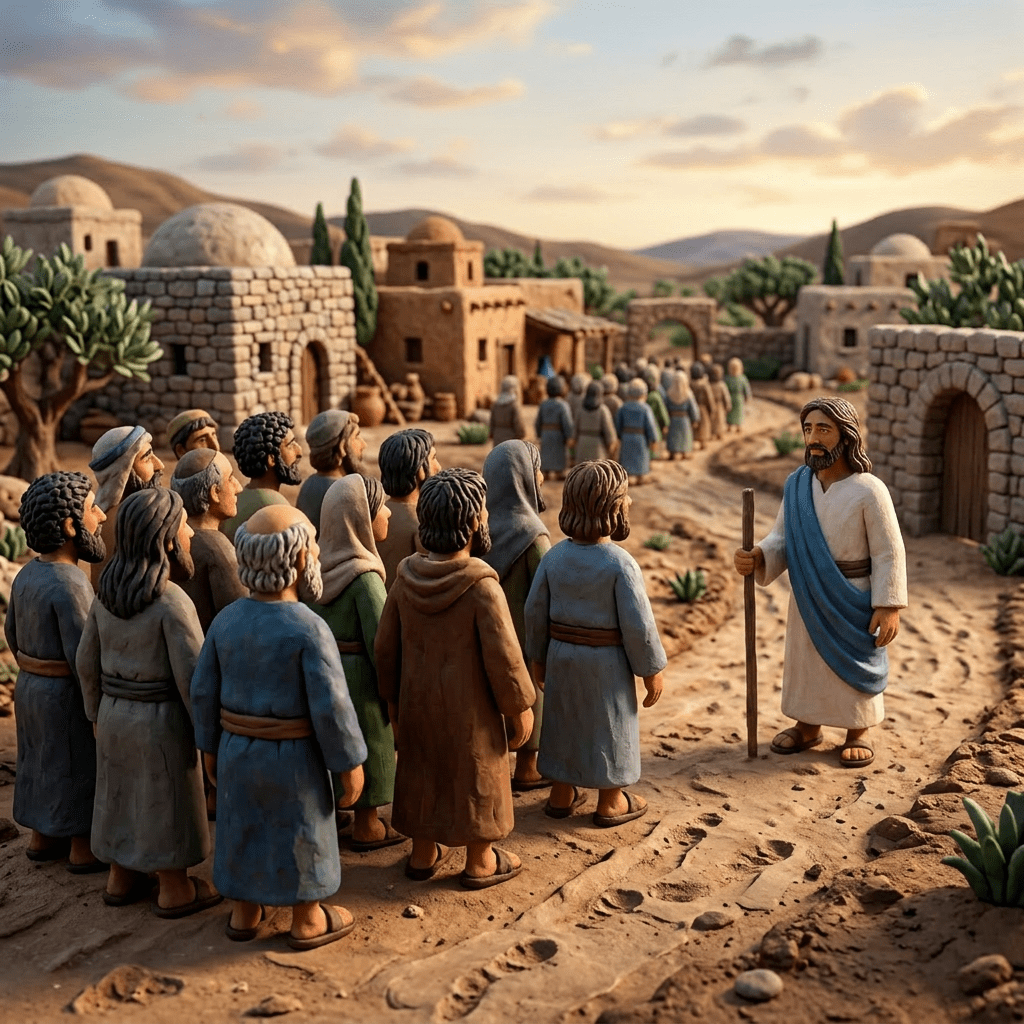
60 When many of his disciples heard it, they said, “This is a hard saying; who can listen to it?” 61 But Jesus, knowing in himself that his disciples were grumbling about this, said to them, “Do you take offence at this? 62 Then what if you were to see the Son of Man ascending to where he was before? 63 It is the Spirit who gives life; the flesh is no help at all. The words that I have spoken to you are spirit and life. 64 But there are some of you who do not believe.” (For Jesus knew from the beginning who those were who did not believe, and who it was who would betray him.) 65 And he said, “This is why I told you that no one can come to me unless it is granted him by the Father.”
66 After this many of his disciples turned back and no longer walked with him. 67 So Jesus said to the Twelve, “Do you want to go away as well?” 68 Simon Peter answered him, “Lord, to whom shall we go? You have the words of eternal life, 69 and we have believed, and have come to know, that you are the Holy One of God.” 70 Jesus answered them, “Did I not choose you, the Twelve? And yet one of you is a devil.” 71 He spoke of Judas the son of Simon Iscariot, for he, one of the Twelve, was going to betray him.
John 6:60-71 ESVUK, with my bold.
The final verse in the last section shows that Jesus’ audience has changed. We are no longer in the Capernaum synagogue, and the audience is Jesus’ disciples, people who follow him. It does not sound like this takes place immediately later either, but they have come to hear how the responce to Jesus teaching was heated and angry. Now the disciples have heard that Jesus said that people are called to eat Jesus’ flesh and dring his blood. They too are grumbling amongst themselves. The first thing Jesus does is not to reassure them, but to talk about his ascension. Then he tries reassurance by talking about the Holy Spirit.
There are no details of either here, and John does not portray the ascension in his account, but he does speak about it after the ascension after Jesus is resurrected. But it does point right back to the beginning of the Gospel. Jesus is the Word made flesh who came down to us full of grace and truth (John 1:14). Jesus is the place where heaven and earth meet.
Where heaven and earth meet was the tabernacle, a mobile temple which the Israelites carries through the desert, made to the pattern God gave to Moses and was carried through the desert with the presence of God leading them in a column of cloud by day and fire by night. Later when Solomon’s Temple was dedicated the glory of God came and filled the Temple. The place where God lived was the Temple and there, in the innermost part behind a curtain was the holiest place or holy of holies, the place where heaven and earth overlapped.
But in Jesus day that is not where heaven and earth overlapped, it overlapped in the word made flesh, in the body of Jesus. The Temple in Jerusalem was being reconstructed. The Temple of Zerubbabel built after the return from exile was a tiny thing compared to Solomon’s temple, also there is no mention of the Ark of the Covenant in that temple, the last mention of the Ark is before the exile in the reign of King Josiah (2 Chronicles 35:3). The Glory of God was absent in both the Temple of Zerubbabel and it’s enlargement started under Herod the Great.
The place where the Glory of God was present on Earth was in the body and blood of Jesus. Jesus was offering people a share in the Glory of God, which will happen when the has ascended to heaven and has sent the Holy Spirit. He said similar things to the woman of Samaria (4:7-36).
But I’m reading ahead here. John says very little about the Spirit of God here, even though it is one of the major themes of his Gospel, he is building up a picture of who Jesus is one bit at a time, building on what he has said before. What he does here is point out that what he had said about eating his flesh and drinking his blood was not meant literally, but was a spiritual teaching (v, 63). He also contrasts the Holy Spirit and the flesh, saying, “the flesh is no help at all” compared to Jesus’ words.
I have put those words in bold because verses 60 to 65 come in the form of a chiasmus. Chiasmus, meaning crossing over, is a form used in nearly all Psalms and often in the New Testament. It is a repetition of similar ideas in the reverse sequence. Where there is a central section it is often the main theme.
The problem here, with Jesus’ followers. is not that they did not understand what Jesus was saying, but that they understood what he was saying, and that meant they had to change. They had to change from a point of view that saw the presence of God as being in a temple. Christians still get this wrong. If you go to church on Sunday expecting to find the presence of God there then you are mistaken, the Spirit of God lives within you, one of his people and it is here that these people congregate as a… erm… congregation to worship God and learn together.
The change that Jesus was calling his followers to was not just to cange their point of view on where God’s presence was on earth, not in a building, but in the person of Jesus, God has become like one of us in order to save us. That would be fine if that was all that there was. But it is far more revolutionary than that. The words of Jesus were not difficult to understand but they were too demanding. They demanded a complete change in your world view, not just in how you think of theology but in the way you act towards God and to other people. And that is a big risk.
Many of the people who followed Jesus were not prepared to take that risk. They liked their Jewish rituals and their prescribed visits to Jerusalem on three feast days a year. The question is, why were they not in Jerusalem? the answer is that they were probably poor, people who could not afford the cost of the journey or accomodation were excused the trip. The jorney to Jerusalem and back would take several days. they were willing to follow a prophet or Messiah figure as long as these figures kept within the agendas they had in mind. Jesus was demanding too much.
So they left. They stopped following Jesus. That they all left except the twelve is a simplification. When Jesus arrives in Jerusalem in chapter 12 there is a large crowd with him. Many who did not understand and were not repelled by Jesus’ teaching would still be there.
As for those who remained, the twelve were still with him, but the effect still remains, people still follow Jesus for their own agenda, for instance, Jesus never said that Christians should have political power.
But the twelve remained. They believed that Jesus was the Word beccome flesh. The word was not just a spiritual idea to them or an idea, or an experience, it was flesh. Jesus was not only talking about the age to come but by his words was beginning to bring it about. When Simon Peter said Jesus had “the words of eternal life” (v. 68) he was speaking for the group who still followed.
Jesus knows that one of the twelve will betray him, but at this point they are all still standing by him. The references to the Israelites in the desert and Jesus’ reply show that he was bringing about a new Exodus, a great movement that will see the world freed from sin and death.
That’s what we have in Chapter 6. how the world will be freed will come as John continues his story about who Jesus is.
< Previous | The Gospel of John | Next >

