
Grumbling
Who is Jesus? part 69 – John 6:35-48
There used to be a lot of starlings settling in Huddersfield town centre. I remember looking at the circling patterns of birds and walking into a lamp post. Pure slapstick. That was 50 years ago, now there are hardly any starlings, definitely not enough for a murmuration, but there are spikes on windowsills. It is said that the bird droppings are the reason, but I’d rather see avian guano than those unsightly spikes uglifying our great Victorian buildings.
Last post I said I’d talk about the people murmuring about Jesus, but the ESV translates it as grumbling. Still I am grumbling about murmurations, or lack of them.
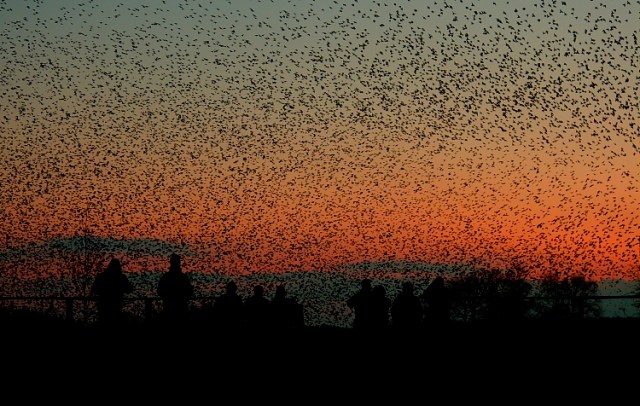
A free image via Wikimedia Commons
A. 35 Jesus said to them, “I am the bread of life;
B. whoever comes to me shall not hunger, and whoever believes in me shall never thirst.
C. 36 But I said to you that you have seen me and yet do not believe.
D. 37 All that the Father gives me will come to me, and whoever comes to me I will never cast out.
E. 38 For I have come down from heaven, not to do my own will but the will of him who sent me. 39 And this is the will of him who sent me, that I should lose nothing of all that he has given me, but raise it up on the last day. 40 For this is the will of my Father, that everyone who looks on the Son and believes in him should have eternal life, and I will raise him up on the last day.”
F. 41 So the Jews grumbled about him, because he said, “I am the bread that came down from heaven.”
X. 42 They said, “Is not this Jesus, the son of Joseph, whose father and mother we know? How does he now say, ‘I have come down from heaven’?”
F’. 43 Jesus answered them, “Do not grumble among yourselves.
E’. 44 No one can come to me unless the Father who sent me draws him. And I will raise him up on the last day.
D’. 45 It is written in the Prophets, ‘And they will all be taught by God.’ Everyone who has heard and learned from the Father comes to me—
C’. 46 not that anyone has seen the Father except he who is from God; he has seen the Father.
B’. 47 Truly, truly, I say to you, whoever believes has eternal life.
A’. 48 I am the bread of life.
John 6:35-48 ESVUK Paragraphs to show the chiamatic structure and bold to show repeated phrases added by me.
I have dealt with verses 35 to 40 in the last post, but I return to it now because this passage as we see it now has a poeiic form, a chiasmus. Chiasmus, meaning crossing over, is a form used in nearly all Psalms and often in the New Testament. It is a repetition of similar ideas in the reverse sequence. Where there is a central section it is often the main theme.
Looking at this structure there is not much to say except that the E section is repeated speaking about Jesus being sent by the Father and being the one who raises the dead at the end of the age. There are two things here, Jesus has been sent, the repeated phrase “he who sent me” in the first telling and talking of “the will of my Father” in the repeat in the E section, and puts the two together in the E’ section, “Father who sent me.” If you think this makes Jesus subservient to the Father, this is how it works whilst he is on Earth, but Jesus is going to be the judge of the world. He is the one who will raise the dead, just as the Father has raised him up. It sounds like scary stuff, until we compare it to the Israelites in the Sinai Desert.
The Israelites had to learn in the desert that God was not there to do what they wanted him to do. He did not rescue them because they were a great nation, nor because they were a particularly moral or spiritual people. There was nothing to commend them to God. It was by God’s choice that they were brought out of Egypt to be God’s people so that they would be a nation who would show God’s purposes to the world. Look at Deuteronomy 7:7-11.
7 It was not because you were more in number than any other people that the Lord set his love on you and chose you, for you were the fewest of all peoples, 8 but it is because the Lord loves you and is keeping the oath that he swore to your fathers, that the Lord has brought you out with a mighty hand and redeemed you from the house of slavery, from the hand of Pharaoh king of Egypt. 9 Know therefore that the Lord your God is God, the faithful God who keeps covenant and steadfast love with those who love him and keep his commandments, to a thousand generations, 10 and repays to their face those who hate him, by destroying them. He will not be slack with one who hates him. He will repay him to his face. 11 You shall therefore be careful to do the commandment and the statutes and the rules that I command you today.
It’s all about God’s will. The surprising thing about this is that its context is Moses talking about how Israel had grumbled to God in the desert.
What were they grumbling about? It was Jesus’ parentage. You can hear the sniggers as they said, “Is not this Jesus, the son of Joseph, whose father and mother we know?” You can imagine them adding, “Joseph’s not his real dad, and wondering how this illigitimate man could be a channel of God.
The people Jesus is talking to in that Capernaum synagogue (we’re told the setting further down), are doing the same thing that Israel did in the desert, grumbling. They are looking for a Messiah who will do what they want and like the Israelites they won’t get it. No wonder that Jesus is going on and on about the will of God. Being part of God’s people does not make you special in and of yourself. It is God alone who is great and all greatness comes from him.
Jesus then says, “And they will all be taught by God,” quoting from Isaiah about the outpouring of God’s love in bringing his people back from exile. Isiah goes on from that to invite everyone who is thirsty to come to the waters and drink. Jesus has just said, “whoever believes in me shall never thirst.”
John Chapter 1 used quotes from Isaiah in three songs, John Chapter 5 uses quotes from Deuteronomy. In Chapter 6 John builds on what he has already said and builds on it by putting these two strands together.
The message of hope in John’s Gospel comes from this passage. Jesus says of those who believe in him that he will “will raise him up on the last day,” a promise that resonates through the Gospel. This is more than life after death, that’s too vague. This is Eternal Life. Eternal life is about quality of life, it is a better life than this one, abundant life, as Jesus said in John 10:10. It is not only for the future, it is the life of the age to come. It starts in the present when someone believes, continues beyond death and will take the form of the resurrection life Jesus spoke about in John 5:25-29. If you believe in Jesus you already have this eternal life.
I’m not too bothered about these people, John refers to them as “the Jews” and would include some of the leaders of the people, they haven’t gone too far to follow Jesus.
Not yet anyway.

