
We were not born of sexual immorality
Who is Jesus? part 91 – John 8:27-43
The best Star Wars film, in my opinion, is Star Wars: Episode V – The Empire Strikes Back. It’s an odd film and finishes in a bad place. Han Solo has been captured, all the victories of the first film in the series, Star Wars, which has just been subtitled Episode VI – A New Hope, have been reversed, and the antagonist has revealed to our hero, Luke Skywalker, that he is Luke’s father. It will take another three years and another film to complete the first trilogy before things are resolved.
The dialogue following Jesus saying, “I am the light of the world,” is a bit like being in the middle of a trilogy. The end is being more than hinted at, but is yet to be realised.
27 They did not understand that he had been speaking to them about the Father. 28 So Jesus said to them, “When you have lifted up the Son of Man, then you will know that I am he, and that I do nothing on my own authority, but speak just as the Father taught me. 29 And he who sent me is with me. He has not left me alone, for I always do the things that are pleasing to him.” 30 As he was saying these things, many believed in him.
31 So Jesus said to the Jews who had believed in him, “If you abide in my word, you are truly my disciples, 32 and you will know the truth, and the truth will set you free.” 33 They answered him, “We are offspring of Abraham and have never been enslaved to anyone. How is it that you say, ‘You will become free’?”
34 Jesus answered them, “Truly, truly, I say to you, everyone who commits sin is a slave[a] to sin. 35 The slave does not remain in the house for ever; the son remains for ever. 36 So if the Son sets you free, you will be free indeed. 37 I know that you are offspring of Abraham; yet you seek to kill me because my word finds no place in you. 38 I speak of what I have seen with my Father, and you do what you have heard from your father.”
39 They answered him, “Abraham is our father.” Jesus said to them, “If you were Abraham’s children, you would be doing the works Abraham did, 40 but now you seek to kill me, a man who has told you the truth that I heard from God. This is not what Abraham did. 41 You are doing the works your father did.” They said to him, “We were not born of sexual immorality. We have one Father—even God.” 42 Jesus said to them, “If God were your Father, you would love me, for I came from God and I am here. I came not of my own accord, but he sent me. 43 Why do you not understand what I say? It is because you cannot bear to hear my word.
John 8:27-43 ESVUK
I am he
Jesus is doing it again, claiming to be God, that is.
The conversation Jesus had with the Jews from John 8:12 to the end of the chapter is made up of three structures, and each one is chiastic. Chiasmus, meaning crossing over, is a mirror-image form used in nearly all Psalms and often in the New Testament. It is a repetition of similar ideas in the reverse sequence. Where there is a central section, it is often the main theme. Last week, we looked at the central section and its flanking passage for context, about being a slave and the relationship between truth and freedom. Today, it is the turn of the outer words.
Very early in this passage, Jesus claims to be God, saying, “I am he” in verse 28. Jesus uses the words “I am” in all three of these structures – In the first section (vv. 12 -26) he Starts with “I am the light of the world,” (v. 12) and moved on to “I am from above,” (v.23) and “I am he, ” (v.24). The last of these is repeated in this second section.
Most commentaries I save read and semons I’ve heard on this subject tend to take the seven statements that say “I am the…” and make them more important than the other “I am” statements, but bear with me here: What if “I am the light of the world,” is the starting point and Jesus (or John) is using these other “I am” statements to build up to something bigger. That is what I see happening here: the crescendo comes in the next part.
But first, there is a problem with the word he in “I am he.” It is not there in the Greek; the problem here is English grammar – the word am needs a noun to follow it, so English translators have added the word “he” which makes the English flow better but reduces the impact of Jesus saying “I am.” Jesus is declaring that he is God in the clearest way so far. Both here and previously in verse 24. This time, Jesus ups the ante, linking the I am statements to him being lifted up. This “I am he” or “I am” is hu in Hebrew and was translated as egō eimi in the Septuagint Greek translation, which is the version the New Testament writers used when quoting the Old Testament. Isaiah uses that phrase between chapters 40 to 50 as a divine self-declaration spoken by Yahweh (the Lord) to establish His absolute uniqueness, eternity, and status as the one true God and Saviour. John is moving on from Jesus as the Word made flesh 1:14 to Jesus self-declaring he is the one true God and Saviour, hence the connection to being lifted up, the means of the whole world being saved. Isaiah 41:4 says:
Who has performed and done this,
calling the generations from the beginning?
I, the Lord, the first,
and with the last; I am he.
We were not born of sexual immorality
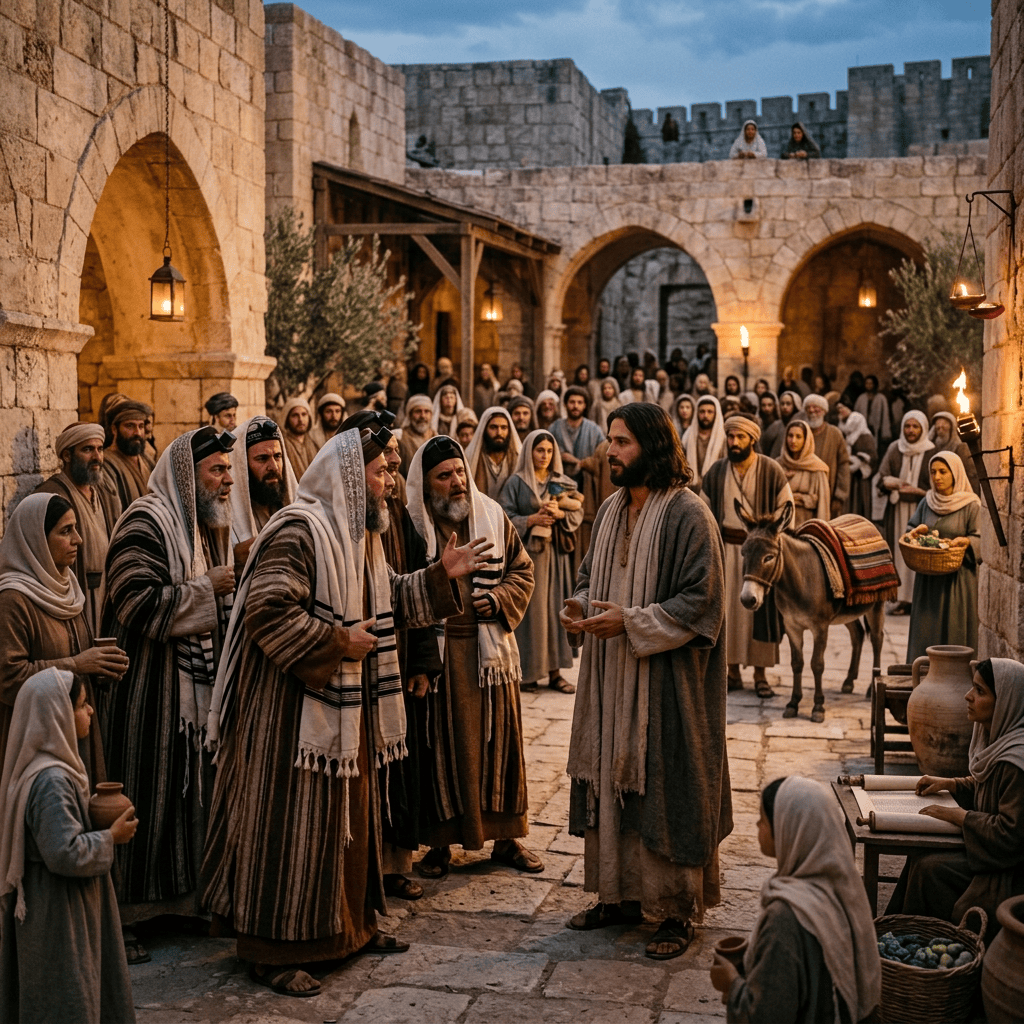
Ever since the Pharisees interrupted Jesus saying “I am the light of the world,” Jesus’ defence has been to talk about his Father and about how he is doing the Father’s will. The first reaction was to ask Jesus, “Who are you?” (verse 25) Jesus answers by saying God is his Father. But as things progress, they go on the offensive. “We were not born of sexual immorality,” says v. 41.
Compare this to Matthew 13:55, “Is not this the carpenter’s son? Is not his mother called Mary? And are not his brothers James and Joseph and Simon and Judas?” They know about Jesus’ background, that he was brought up as the child of Joseph and Mary, and of the rumours that Joseph wasn’t Jesus’ real dad. The Jews had claimed to be children of Abraham, a purely genetic link, and Jesus said they were not acting as Abraham would have done. Thus, they were not acting as Abraham’s children. Their reply is a nod to Jesus’ rumoured illegitimacy, and they add that their father is God.
This passage and the one following have some of Jesus’ harshest words against his people, in a stark contrast to their growing hate and clutching at straws to condemn Jesus, he is still reaching out to them. Words like “You will die in your sins” (verse 24) are giving them one last chance to save themselves. He says, “When you have lifted up the Son of Man,” (verse 28, my bold), showing that the fault of this coming crucifixion under the Roman authorities will lie with them.
The death in their sins is more than just about an inward spiritual conditions that take place within the heart and soul; Jesus is also warning about political events that were coming in the Middle East at that time. Jesus knew it, and they knew it. It’s spoiler time again. In Chapter 11, Caiaphas, the High Priest, will warn his fellow leaders that if they are not careful, the Romans will destroy the holy city of Jerusalem. They did, in 70 AD.
Jesus knows he will not be with them for long. His warnings are a cry of love to his people, a last chance for them to repent and follow him. But Jesus also realised that they wouldn’t follow him. They could not understand that the God they thought they knew could be the same God that Jesus preached. So they accuse Jesus, in what is now called projection, of accusing someone of what you are guilty of yourself.
< Previous | The Gospel of John | Next >

