
Never see death
Who is Jesus? part 92 – John 8:44-59
What do you remember about the last political debate you saw?
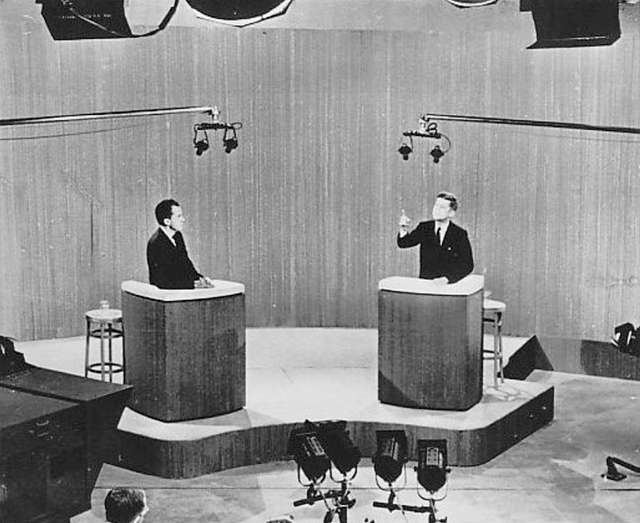
Was it the nuanced questions being asked, or the depth of the reasoning in the answers? I thought not. Because that is not what the candidates are after. You can tell that by what they say after the event, it’s about who won. Quite often they all claim to have won. So often there is no debate, just people saying their prepares speaches and getting upset if they get contradicted.
There’s nothing new as you will see.
44 You are of your father the devil, and your will is to do your father’s desires. He was a murderer from the beginning, and has nothing to do with the truth, because there is no truth in him. When he lies, he speaks out of his own character, for he is a liar and the father of lies. 45 But because I tell the truth, you do not believe me. 46 Which one of you convicts me of sin? If I tell the truth, why do you not believe me? 47 Whoever is of God hears the words of God. The reason why you do not hear them is that you are not of God.”
48 The Jews answered him, “Are we not right in saying that you are a Samaritan and have a demon?” 49 Jesus answered, “I do not have a demon, but I honour my Father, and you dishonour me. 50 Yet I do not seek my own glory; there is One who seeks it, and he is the judge. 51 Truly, truly, I say to you, if anyone keeps my word, he will never see death.” 52 The Jews said to him, “Now we know that you have a demon! Abraham died, as did the prophets, yet you say, ‘If anyone keeps my word, he will never taste death.’ 53 Are you greater than our father Abraham, who died? And the prophets died! Who do you make yourself out to be?” 54 Jesus answered, “If I glorify myself, my glory is nothing. It is my Father who glorifies me, of whom you say, ‘He is our God.’ 55 But you have not known him. I know him. If I were to say that I do not know him, I would be a liar like you, but I do know him and I keep his word. 56 Your father Abraham rejoiced that he would see my day. He saw it and was glad.” 57 So the Jews said to him, “You are not yet fifty years old, and have you seen Abraham?” 58 Jesus said to them, “Truly, truly, I say to you, before Abraham was, I am.” 59 So they picked up stones to throw at him, but Jesus hid himself and went out of the temple.
John 8:44-59 ESVUK
I have removed the heading. It got in the way of seeing the form of the passage. The form is of the debate between Jesus and several groups of people which started with Jesus saying “I am the Light of the World.” That form is of three chiasmuses, from John 8:12-26, 8:27-43 and 8:44-59. Chiasmus, meaning crossing over, is a mirror-image form used in nearly all Psalms and often in the New Testament. It is a repetition of similar ideas in the reverse sequence. Where there is a central section it is often the main theme.
The central themes so far have been the words of Jesus:
vv. 21-24 Performing circumcision on the Sabbath;
vv. 34-35 “Whosoever committeth sin is the servant of sin.”
v. 51 “If a man keep my saying, he shall never see death.”
It’s progressive, moving from keeping the law through the nature of sin through to eternal life.
It’s clear they won’t listen.
The build up
But first the build up. Jesus is being as harsh as he ever is. The first and last parts contrast the spiritual fatherhood of the Jews, being of the devil, to their forefather Abraham. This is what the next post is about, so I’ll leave that for now.
Moving towards the centre we have the subject of lies. (Jesus taught about truth in the last part). The devil, the spiritual father of the Pharisees, has been a liar from the beginning contrasts with Jesus saying that he would be a liar if he denied that God was his Father.
We’re halfway to the centre now and Jesus is talking about God and how you cannot hear from God if you go against him.
The centre
Now it’s the turn of the other side in the debate. Debate not dialogue because they are wanting to score points off Jesus, not listen to him and consider what he is saying. So they increase the insults. They have already said, “We were not born of fornication,” pointing to Mary being pregnant before she and Joseph were married. But now they are just throwing the worst insults they can find, with neither fact nor rumour to substantiate their claims.
They call Jesus a Samaritan; to call a Jew a Samaritan was a gross insult, then they topped it off with demon possessed. But Jesus does not reply to this racial slur, nor to the implication that like the Samaritans he is a heretic. They are trying to dishonour him, but Jesus is not after his own honour, he is honouring the Father. Jesus’ detractors, in this case the Jews, which John uses throughout his Gospel to mean the Jews living in Judea, have moved on from projection, accusing people of things they are guilty of, to downright insulting lies. We see this in political debates to this day. If you cannot answer someone’s questions, revert to insults.
Instead, in v. 51, Jesus tells a joke, a very dark one, though it is hard to spot it’s a joke in English translations. I do not believe that Jesus is saying his followers will not face physical death, so the obvious thing would be to say that he’s talking about spiritual death. My problem is that I don’t believe that either; it just does not fit into the context of the whole passage, nor the spirit of John’s Gospel either.
Obeying rules is what the Pharisees did. They were rigid in their obedience of Sabbath rules, both those in the Bible and their own additions. Their arguments against Jesus in chapter 7 began with them criticising Jesus for healing on a Sabbath. Jesus’ teaching contrasts with that of the Pharisees, he is far more interested in the needs of people than he is in rigid rule keeping. To find out what Jesus is saying the Greek is needed and to get at the Greek I’m using the Blue Letter Bible.
Verse 51 has Jesus saying, “Truly, truly, I say to you, if anyone keeps my word, he will never see death.” There is only one word about seeing in that verse. In Greek there are two, and they work together. The first seeing word is translated keeps in the ESV. Greek has τηρῇς, tereon. From τερός terós (a watch); to guard (from loss or injury, properly, by keeping the eye upon); so if anyone keeps an eye on Jesus’ word, “word” being logos, the Word that became flesh in 1:14. Themes keep coming back in John’s Gospel. The second seeing word, in “he will never see death,” is θεωρέω theoreo, from which we get the word theatre. It is about viewing something other than death, so it does not mean “he will never see his own death,” but he will not see the things that bring death. The importance of being focussed on the word that brings life 1:4 and 6:63.
Tradition-centred religion, without Christ, is often a “mutual admiration society” for people who want the praise of other people, says Warren Wiersbe.1 He is commenting on this passage, pointing us away from the religion of the groups in this passage.
< Previous | The Gospel of John | Next >
1 Wiersbe, Warren W.. The BE Series Bundle: The Gospels: Be Loyal, Be Diligent, Be Compassionate, Be Courageous, Be Alive, and Be Transformed (The BE Series Commentary) (p. 981). David C Cook. Kindle Edition.

