
A Prophet?
Who is Jesus? part 63 – John 6:1-15
They say there is no such thing as a free lunch. Read on…
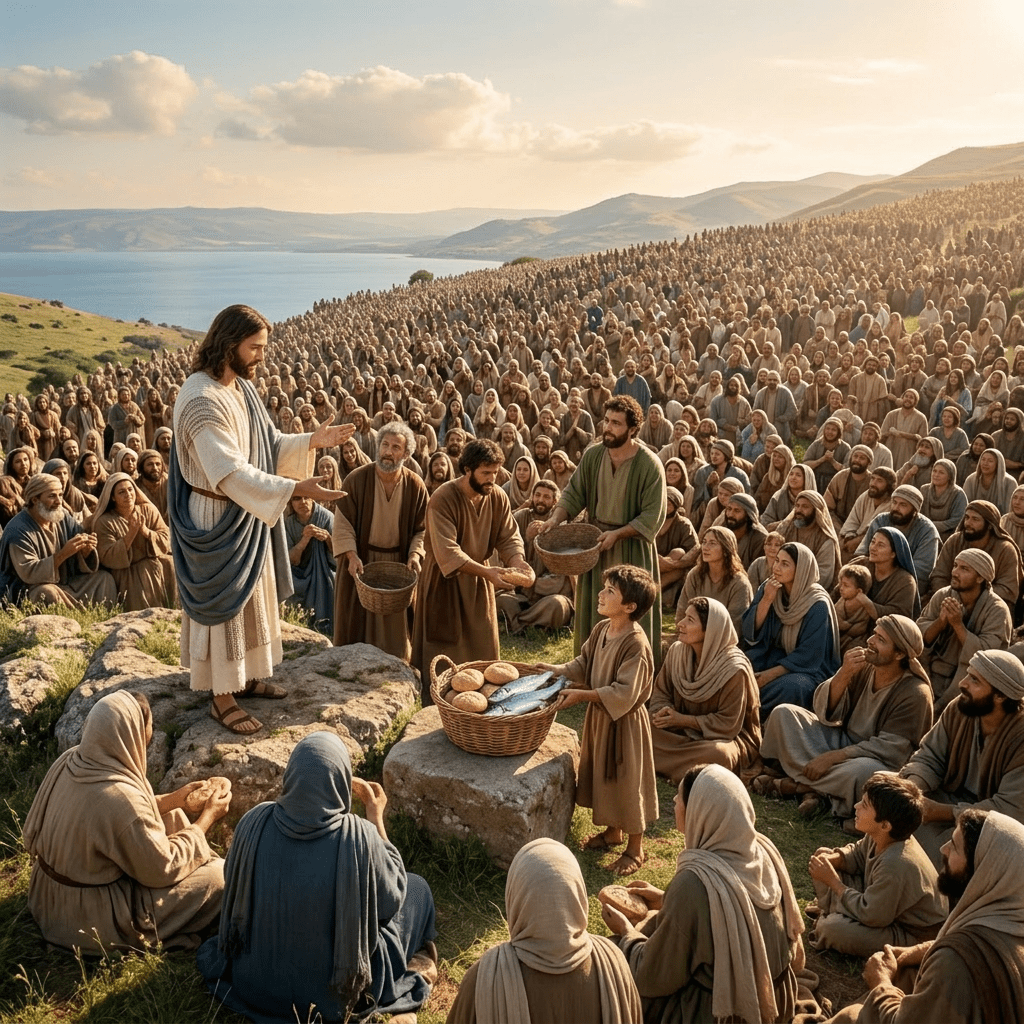
6 After this Jesus went away to the other side of the Sea of Galilee, which is the Sea of Tiberias. 2 And a large crowd was following him, because they saw the signs that he was doing on the sick. 3 Jesus went up on the mountain, and there he sat down with his disciples. 4 Now the Passover, the feast of the Jews, was at hand. 5 Lifting up his eyes, then, and seeing that a large crowd was coming towards him, Jesus said to Philip, “Where are we to buy bread, so that these people may eat?” 6 He said this to test him, for he himself knew what he would do. 7 Philip answered him, “Two hundred denarii would not buy enough bread for each of them to get a little.” 8 One of his disciples, Andrew, Simon Peter’s brother, said to him, 9 “There is a boy here who has five barley loaves and two fish, but what are they for so many?” 10 Jesus said, “Make the people sit down.” Now there was much grass in the place. So the men sat down, about five thousand in number. 11 Jesus then took the loaves, and when he had given thanks, he distributed them to those who were seated. So also the fish, as much as they wanted. 12 And when they had eaten their fill, he told his disciples, “Gather up the leftover fragments, that nothing may be lost.” 13 So they gathered them up and filled twelve baskets with fragments from the five barley loaves left by those who had eaten. 14 When the people saw the sign that he had done, they said, “This is indeed the Prophet who is to come into the world!”
15 Perceiving then that they were about to come and take him by force to make him king, Jesus withdrew again to the mountain by himself.
John 6:1-15 ESVUK
Signs and sign.
What makes up a sign in John’s Gospel? There are two different meanings of sign or signs in this passage. Verse 2 says, “And a large crowd was following him, because they saw the signs that he was doing on the sick.” and verse 14 says, “When the people saw the sign that he had done, they said, ‘This is indeed the Prophet who is to come into the world!'” The signs in verse 2 are plural and point to the many healings and other miracles Jesus was performing. This is not the first time these many signs have been mentioned. 2:23 says, “Now when he was in Jerusalem at the Passover Feast, many believed in his name when they saw the signs that he was doing.”
But John does not give any details of these many signs. Instead, he points out seven signs that indicate the purpose of Jesus’ ministry and who Jesus was. I said seven because that number is a bit of a theme in this Gospel, which I’ll look at when I’ve completed my examination of this sign, which is in four parts. 1. The location, 2. When it happened, 3. (this one) The meaning to those who received it, and 4. The meaning to the disciples.
A multiplication of food
This sign shows a multiplication of food, but it is not the first time in the Bible. Elijah did it. 1 Kings 17 says, “The jar of flour will not be used up and the jug of oil will not run dry until the day the LORD gives rain on the land.” Elishadid it also. iIn 2 Kings 4, he increases the amount in a oil in a jug to fill several large jars and also feeds 100 men with 10 barley loaves, with food left over.
Elisha in particular was a miracle working prophet whose ministry focused on miracles that demonstrated God’s active, saving presence in the Kingdom of Israel. His feeding of 100 men with ten barley loaves is ecoed in Jesus feeding far more people, Matthew tells us the crowd was 5,000 men plus women and children, with less food, one boy’s packed lunch of five barley loaves and two small fish.
This fourth sign (fifth if you are from the reformed tradition) of multiplying food, which is mostly bread is,when taken together with Jesus first sign which was a tranformation of water into wine gives us the elements Jesus used at his last supper. But that would not have been understood by the crowd there, but they definately made the connection between miracles with food and the prophets, particularly Elisha. They see Jesus as a prophet and want to make him into the type of Messiah they want, a warrior king who will beat the Romans.
They want great things for Jesus, but they are things Jesus does not want. He walks away.
< Previous | The Gospel of John | Next >

