
Passover part 2
Who is Jesus? part 62 – John 6:1-14 part 2
There is a statue outside the Accu Stadium in Huddersfield, which has had several names, including John Smith’s Stadium, Galpharm Stadium, and Alfred McAlpine Stadium. The statue honors Herbert Chapman, the manager who led Huddersfield Town to win the FA Cup and the league three times in a row, a first for any team. Chapman later managed Arsenal, where he also won the league three times. Arsenal funded the statue.
Those glory days are now a century ago. Following Huddersfield these days is a mixture of optimism followed by disappointment.
Chapter 6 of the Gospel according to Saint John is like that, a tale of optimism followed by disappointment.
6 After this Jesus went away to the other side of the Sea of Galilee, which is the Sea of Tiberias. 2 And a large crowd was following him, because they saw the signs that he was doing on the sick. 3 Jesus went up on the mountain, and there he sat down with his disciples. 4 Now the Passover, the feast of the Jews, was at hand. 5 Lifting up his eyes, then, and seeing that a large crowd was coming towards him, Jesus said to Philip, “Where are we to buy bread, so that these people may eat?” 6 He said this to test him, for he himself knew what he would do. 7 Philip answered him, “Two hundred denarii[a] would not buy enough bread for each of them to get a little.” 8 One of his disciples, Andrew, Simon Peter’s brother, said to him, 9 “There is a boy here who has five barley loaves and two fish, but what are they for so many?” 10 Jesus said, “Make the people sit down.” Now there was much grass in the place. So the men sat down, about five thousand in number. 11 Jesus then took the loaves, and when he had given thanks, he distributed them to those who were seated. So also the fish, as much as they wanted. 12 And when they had eaten their fill, he told his disciples, “Gather up the leftover fragments, that nothing may be lost.” 13 So they gathered them up and filled twelve baskets with fragments from the five barley loaves left by those who had eaten. 14 When the people saw the sign that he had done, they said, “This is indeed the Prophet who is to come into the world!”
15 Perceiving then that they were about to come and take him by force to make him king, Jesus withdrew again to the mountain by himself.
John 6:1-14
Speaking of disappointment, I got up this morning, wrote the introduction to this post, and found that the whole of my commentary on this passage had disappeared with nothing showing in past revisions of the text. All because I did not save last night, a whole day’s writing has gone.
The feeding of the 5,000 is the only miracle to appear in all four of the Gospel accounts. It is the only one of these accounts that mentions that the event happened at Passover. According to theologian and bishop N.T. Wright, John’s Gospel does not waste any words. Even the smallest details have a purpose. So what is so important about Passover?
This is the second of three times that John has mentioned the Passover. The first in 2:13-16 shows Jesus driving out the temple traders, and the third is his final visit to Jerusalem. But there’s more to it than that; John, who does not mention Jesus’ last supper with his disciples in his account of Jesus’ life, shows the breaking of bread here in a similar way: giving thanks, breaking the bread, and giving to the disciples. John’s readers would know about Jesus’ last supper, as its commemoration would have been already common among Jesus’ followers at the time of writing. This parallel is for us and anyone who already knows about and commemorates Jesus’ last supper.
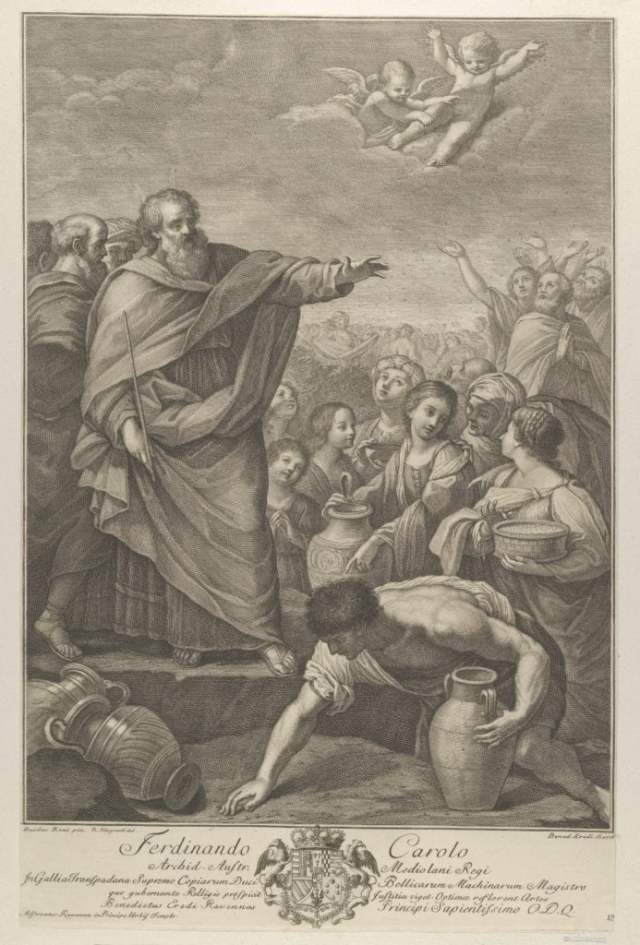
The crowd, who had no idea that Jesus would share a last supper, would have drawn a different parallel, Moses. Their Passover celebration remembered not just the Passover, when the Angel of Death passed over the houses of the Israelites, it also celebrated the whole of the journey through the desert to the Promised Land.
On that trip, Moses prayed to God, who provided water and manna, followed by quails for food. There are several parallels in this story. The crowd’s reaction to being fed is clear; they view Jesus not just as a prophet, but as someone worthy of being proclaimed king. They see Jesus as their Messiah, called Christ in Greek, which means God’s anointed, who like Moses, who would come to save Israel.
They were right about Jesus being Messiah, but wrom about how the Messiah would save them. The people were optimistic, but Jesus was not. The next post in this series will pick up on the prophet and king images.
< Previous | The Gospel of John | Next >

