
Casting the first stone
Who is Jesus? part 83 – John 7:53-7:11
Time has passed, it’s too late to say anything, and another opportunity has been missed. It is only then that you think of the reply. But it’s too late. We have all been there. Those times when a caring reply or a witty reply has been missed. Spontaneity has failed us, and we are left with the cruel taskmaster that is regret. If only we’d paused to think.
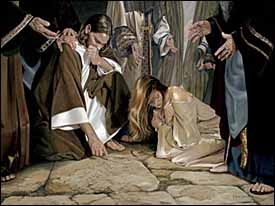
53 [[They went each to his own house, 1 but Jesus went to the Mount of Olives. 2 Early in the morning he came again to the temple. All the people came to him, and he sat down and taught them. 3 The scribes and the Pharisees brought a woman who had been caught in adultery, and placing her in the midst 4 they said to him, “Teacher, this woman has been caught in the act of adultery. 5 Now in the Law Moses commanded us to stone such women. So what do you say?” 6 This they said to test him, that they might have some charge to bring against him. Jesus bent down and wrote with his finger on the ground. 7 And as they continued to ask him, he stood up and said to them, “Let him who is without sin among you be the first to throw a stone at her.” 8 And once more he bent down and wrote on the ground. 9 But when they heard it, they went away one by one, beginning with the older ones, and Jesus was left alone with the woman standing before him. 10 Jesus stood up and said to her, “Woman, where are they? Has no one condemned you?” 11 She said, “No one, Lord.” And Jesus said, “Neither do I condemn you; go, and from now on sin no more.”]]
John 7:53-7:11 ESVUK with paragraphs added for structure
I finished the last post by saying Jesus stooped to write on the ground twice. This gives the clue as to how the passage is structured. This is one of those mirror-image passages called a chiasmus, meaning crossing over; it is a form used in nearly all Psalms and often in the New Testament. It is a repetition of similar ideas in the reverse sequence. Where there is a central section, it is often the main theme.
The central theme here is Jesus’ words, “Let him who is without sin among you be the first to throw a stone at her.” Instead of passing judgment on the woman, Jesus passed judgment on the judges. Saying this was not without the risk that one of them would pick up a stone. But in context, I do not think that Jesus was saying, “Let him who has never sinned.” Can you imagine the chaos applying it that way would cause? Prisons would be empty because judges’ benches would be empty. Instead of absolute sinlessness, I would interpret this as anyone who is without sin in this matter.
Look at the Jewish law. Moses did not receive the Law so that people could act like these Scribes and Pharisees. The Law is not designed to save us; it was given to the Israelites after God had saved them from Egypt. Instead, it is to shine a spotlight on our motives. To show us what we are like.
It was required by Jewish law that the accusers cast the first stones (Deut. 17:7). That’s why I ask a question: Were the Scribes and Pharisees involved, setting up a man so that they could catch Jesus out? Seriously, where was the man? Or the woman? Because if she were caught in an act of adultery, having sex with someone who wasn’t her husband or, if single, sex with someone else’s husband or wife, then where is the other person? If she were caught in an act of adultery, someone else had to be there for her to be caught in the act with. The Scribes and Pharisees, people who studied the law, got the law wrong. When someone is caught in an act of adultery, the law requires that they both be stoned to death. Was there a man involved who was set up to have sex with the woman so that she could be brought before Jesus?
Why didn’t the Scribes and Pharisees pick up a stone? Was it because they were involved in the set-up, or were they simply scared of Rome? Jesus, when previously asked a question about the Jewish law, went back to a period before the law was given for his answer. This time, he agrees with their accusation and asks for someone who is accusing the woman who is not involved in the set-up to do what the law requires.
Now we come to possibiliy three. They may be embarrassed to do this in front of the crowd. The tables have been figuratively turned, it’s their turn to act. Sheeplishly one by one thet dissapear leaving just Jesus, the audience who were listening to him preach and the woman. Kkindness and grace win out over unfeeling legality. The accusers knew the law, but they did not have the Holy Spirit.
< Previous | The Gospel of John | Next >
Wiersbe, Warren W. The BE Series Bundle: The Gospels: Be Loyal, Be Diligent, Be Compassionate, Be Courageous, Be Alive, and Be Transformed (The BE Series Commentary) (p. 972). David C Cook. Kindle Edition.

