
A song about faithfulness
Songs in the New Testament, part 9 – Hebrews 11:32-38
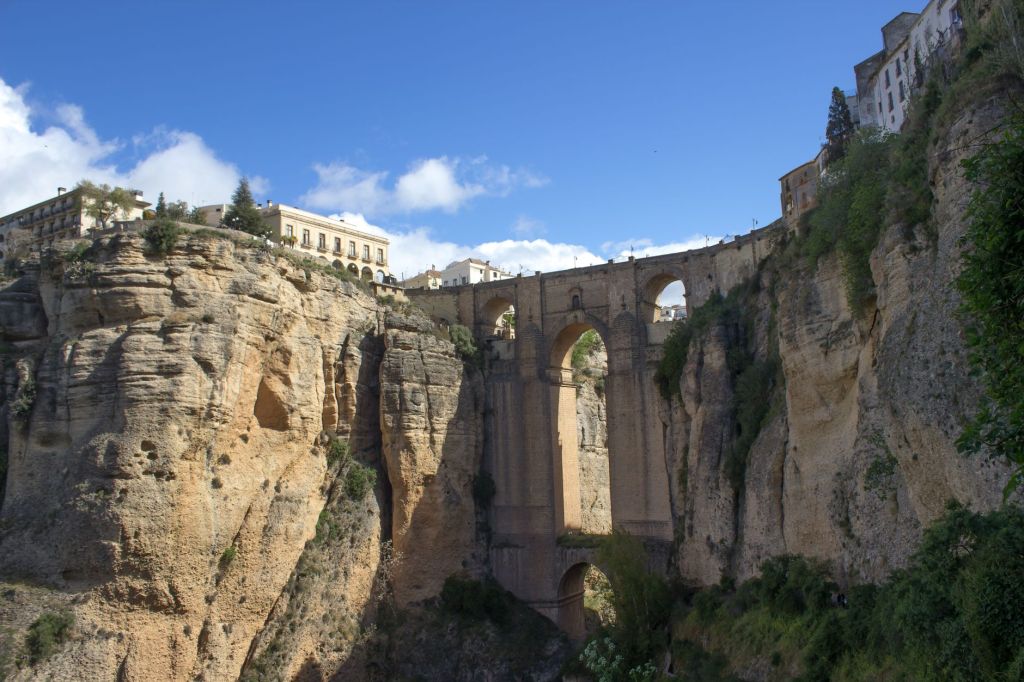
A few years ago we had a holiday on the Costa del Sol, Spain. On of those days was taken up by a visit to Ronda in the mountains above Marbella. The 120 metre deep ravine (390 feet) that splits the city in two was not caused by the 1755 Lisbon Earthquake, as we were misinformed by our tour guide, but it did damage or destroy many buildings as well as hamper the attempts to rebuild the bridge across the ravine which had collapsed three years previously. The bridge is still called the Puente Nuevo (New Bridge) despite being completed in 1793.
The power of the Lisbon Earthquake was phenominal. Ronda is 590 km from Lisbon and 800 km (500 miles) from the earthquake’s epicentre. This disaster and others have caused people to ask why God allows bad things to happen to good people, it even has a theological name, theodicy. During my childhood these questions had arisen again following Word War II.
32 And what more shall I say? For time would fail me to tell of Gideon, Barak, Samson, Jephthah, of David and Samuel and the prophets— 33 who through faith conquered kingdoms, enforced justice, obtained promises, stopped the mouths of lions, 34 quenched the power of fire, escaped the edge of the sword, were made strong out of weakness, became mighty in war, put foreign armies to flight. 35 Women received back their dead by resurrection. Some were tortured, refusing to accept release, so that they might rise again to a better life.
36 Others suffered mocking and flogging, and even chains and imprisonment. 37 They were stoned, they were sawn in two, they were killed with the sword. They went about in skins of sheep and goats, destitute, afflicted, mistreated— 38 of whom the world was not worthy—wandering about in deserts and mountains, and in dens and caves of the earth.
Hebrews 11:32-38
In February 1999 Glenn Hoddle, who described himself as a Born Again Christian, was sacked as Manager of the England football team for his comments about people with disabilities. He suggested that they were suffering from “Karma” due to sins committed in a previous life. He was widely quoted as saying: “You have to reap what you sow… What you sow in previous lives, you have to reap.”
This caused an uproar and condemnation from politicians, including Prime Minister Tony Blair. As a disabled person I found it distressing, Despite Hoddle’s apology the media frenzy led to the Football Association terminating his contract.
Hoddle is not alone as a Christian talking about a wheel of fate like this. This idea is common in other religions such as Buddhism and Hinduism, but it is not the belief of Judaism or Christianity. Their view of the physical body is entirely different. The bodily world is a good thing, both in general and the human body in particular. There is evil: It’s like a parasite acting on a basically good world. This highlights the problem of why bad things do happen to good people?
Which brings us to this song. All of them were in terrifying situations, some survived, some did not. And yet it is a song of praise to people’s faithfulness to God. Instead of being negative and complaining it is a song of hope. What hope is there in adsversity?
Some come up with theories that minimise the hurt to those with faith, such as they believed in God, so it wasn’t that bad. The point of these verses is that it is bad, very bad indeed; being persecuted is a very bad thing. You can’t minimise the cost.
In chapter 10, just before this passage it says:
“Yet a little while,
Hebrews 10:37-38
and the coming one will come and will not delay;
38 but my righteous one shall live by faith,
and if he shrinks back,
my soul has no pleasure in him.”
It is the faithfulness of Jesus, the righteous one in verse 38, who lives by faith. We have faith in a faithful God. In Jesus we see both the subject, the one who has faith, and the object, the one we have faith in.
Take some time out, read the whole of chapter 11. It speaks of three characters before this list, Abel, Abraham and Moses. Abel was killed by Cain because God accepted Cain’s offering of what he had. All three of them believed in God’s faithfulness. That God would do what he said. God is both the subject and object of faith.
And the answer of why do bad things happen to bad people? The Bible has no answer, instead it promises persecution to those who believe in Jesus. In asking that question we want to know why persecuted people are not worthy, or of what they have done wrong. The idea pervades popular culture such as the Travis song Why does it Always Rain on Me. But if you change the question around you get something like this passage of those of whom the world was not worthy.
Jesus warned the disciples about this, saying in his last teaching before his death, “I have said all these things to you to keep you from falling away. 2 They will put you out of the synagogues. Indeed, the hour is coming when whoever kills you will think he is offering service to God.” (John 16:1-2). he then went on to teach them about the Holy Spirit before returning to talk about persecution. “I have said these things to you, that in me you may have peace.” says Jesus in verse 33, “In the world you will have tribulation. But take heart; I have overcome the world.”
The world does not know the Father or Jesus, and the Holy Spirit is not active in the hearts of persecutors. That is why the world hated Jesus, if it hated him it will hate us also. So why should we be of good cheer? Because there is another country. In Jesus the Kingdom of God was present on Earth and there is a tome coming when the Earth will be full of the Glory of God. The Hope of Christians is in resurrection. At a time which the Bible variously calls the end of the age, or the new (or renewed) Heaven and Earth we shall be raised.
We shall be raised. Now that is worth singing about.
<Previous | Songs in the New Testament | Next >

