
The Lamb of God
Who is Jesus? part 81 – John 1:29-34
I took a break in this series on the Gospel of John. The mention of water in chapter 7 showed me things I’d missed when looking at the Samaritan Woman in chapter 4. It was a convenient place to go back, so I compared this meeting at a well with other encounters at wells in the Old Testament. That was the last Friday blog post.
Seeing as I’m paused, there is another encounter with flowing water; it’s worth taking a look at. Jesus’ encounter at the River Jordan with John the Baptist, and the connection to the Jewish sacrifice tradition.
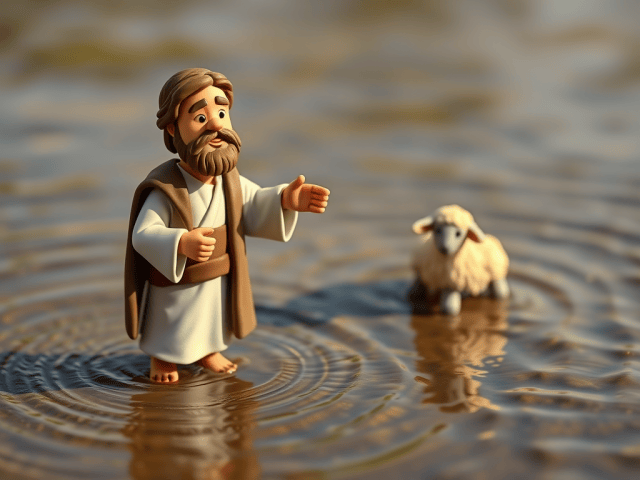
10 “If his gift for a burnt offering is from the flock, from the sheep or goats, he shall bring a male without blemish, 11 and he shall kill it on the north side of the altar before the Lord, and Aaron’s sons the priests shall throw its blood against the sides of the altar.
Leviticus 1:10-11
29 The next day he saw Jesus coming towards him, and said, “Behold, the Lamb of God, who takes away the sin of the world! 30 This is he of whom I said, ‘After me comes a man who ranks before me, because he was before me.’ 31 I myself did not know him, but for this purpose I came baptizing with water, that he might be revealed to Israel.” 32 And John bore witness: “I saw the Spirit descend from heaven like a dove, and it remained on him. 33 I myself did not know him, but he who sent me to baptize with water said to me, ‘He on whom you see the Spirit descend and remain, this is he who baptizes with the Holy Spirit.’ 34 And I have seen and have borne witness that this is the Son of God.
John 1:29-34 both ESVUK
The main offerings of the Jewish system are set out in Leviticus chapters 1 to 5. I have used Google AI and Copilot because I was finding it difficult to summarise this teaching into something simple.
The Five Major Offerings
Burnt Offering (Olah):
- Purpose: Complete surrender, devotion, and general atonement for a person’s sin.
- Nature: Entirely burned on the altar so the smoke rose up to God as a pleasing aroma (an unblemished bull, sheep, goat, or bird).
Grain Offering (Minchah):
- Purpose: Tribute, gratitude for God’s provision, and support for the priests.
- Nature: Fine flour, oil, and frankincense; a small portion was burned on the altar, and the rest eaten by the priests.
Peace Offering (Shlamim):
- Purpose: Fellowship, thanksgiving, or a vowed pledge celebrating peace with God.
- Nature: A shared meal involving God (fat burned on the altar), the priests, and the offerer.
Sin / Purification Offering (Hatta’at):
- Purpose: Atonement for unintentional sin or ceremonial uncleanness.
- Nature: Mandatory; required an unblemished animal scaled by the status of the person who sinned (from a bull for the high priest to a female goat or lamb for an individual).
Trespass / Guilt Offering (Asham):
- Purpose: Reparation for sins that wronged others or desecrated holy things.
- Nature: Mandatory; required a ram plus full financial restitution of the damaged value, plus an additional 20% penalty to the injured party.
These all point to different aspects of Jesus in the New Testament.
Burnt Offering — His complete obedience
Grain Offering — His perfect life
Peace Offering — His reconciling fellowship
Sin Offering — His atoning sacrifice
Guilt Offering — His restorative justice
That’s the AI section done. I find it good as a starting point, but would not use it as a conclusion or where relationships are involved.
Animals used in the sacrificial system had to be pure, and it was the job of the temple priests to attest to the purity of these beasts before they were ritually slaughtered. Now, a Jewish Priest was a hereditary post, and John the Baptist was the son of Zebedee, a Jerusalem priest. John was qualified by birth and was a witness to Jesus, and attests to him as a clean, spotless sacrificial animal. Jesus passes the test of the sacrifice of God.
But there is another parallel to the Old Testament. The Ark of the Covenant crossing the Jordan. The Ark was the box which contained the stone tablets, Arron’s rod, but most importantly, it was where the Shekinah, the Glory of God, was, now that it was no longer leading them through the desert.
14 So when the people set out from their tents to pass over the Jordan with the priests bearing the ark of the covenant before the people, 15 and as soon as those bearing the ark had come as far as the Jordan, and the feet of the priests bearing the ark were dipped in the brink of the water (now the Jordan overflows all its banks throughout the time of harvest), 16 the waters coming down from above stood and rose up in a heap very far away, at Adam, the city that is beside Zarethan, and those flowing down towards the Sea of the Arabah, the Salt Sea, were completely cut off. And the people passed over opposite Jericho. 17 Now the priests bearing the ark of the covenant of the Lord stood firmly on dry ground in the midst of the Jordan, and all Israel was passing over on dry ground until all the nation finished passing over the Jordan.
Joshua 3:14-17
Jesus comes to the Jordan. The Ark of the Covenant has been missing since the time of the exile in Babylon, and the Glory of God is no longer in the temple. Yet the rituals go on without God’s presence being there. Then Jesus, in whom the Glory of God is living unseen, comes and stands in the river. It signifies that a new kingdom is entering the land in the form of Jesus Christ. The Kingdom of God has stood in the Jordan again. Last time it was for God’s people, this time it was for the whole world.
There is a lot more that can be said about Jesus being the perfect sacrifice and Jesus’ baptism being the start of a new kingdom, but that would take me too far away from my subject of Who is Jesus, taken from John’s Gospel.
< Previous | The Gospel of John | Next >


Pauses are as good in life as they are in music.
It is so good to stop our minds in their busy workings and sorting, just to pause and look at Jesus.
Thank you Steve for just such a pause.
Thank you for your reply.
Rest is best. Look at Genesis chapter 1 from man’s point of view. God gives the newly created man authority over creation, and then, instead of sending him out to have dominion immediately, God tells the man to rest. For man, rest is not something to do once we have exhausted ourselves. We need to be rested before we can work.
Steve.